
Related Posts


A plumbing website needs to work in two very different situations. Someone with a leaking pipe may want to call immediately. A homeowner comparing water heater replacements may need to understand equipment options, installation experience and what happens during an estimate.

The best plumbing website design agencies plan for both. They make urgent contact straightforward while giving customers enough information to choose your company for larger, planned jobs.
Choosing an agency involves more than comparing attractive homepages. You need to understand what the website costs, who writes the content, how inquiries reach your team and whether you can take the site with you if you change providers.
For many business owners, the aim is to attract more customers without adding complexity to the working day. Effective plumber websites connect search engine optimization with clear service information and a reliable contact process. A well optimized site should help potential customers understand the business at first glance, then guide them toward the right next step.
This guide compares ten website design agencies serving plumbing businesses in the United States, with pricing where available, relevant client evidence and practical questions to ask before signing.
Editorial note: Nearlead is the publisher-affiliated selection and appears first by editorial choice. This is a shortlist for different business needs, not an independently scored performance ranking. Information was reviewed in October 2026 for this 2027 guide. Confirm current pricing and contract terms directly with each provider.
Compare the Best Plumbing Website Design Agencies
| Agency | Worth considering for | Website pricing | Important consideration |
|---|---|---|---|
| 1. Nearlead | A clearly priced website project with optional ongoing marketing | $3,500 one-time fee, or included at no additional cost with a marketing retainer | Confirm page scope, hosting, ownership and retainer terms |
| 2. Hook Agency | Plumbing companies combining a website with ongoing search marketing | Standard: $12,000 over 12 months; custom: $24,000 over 12 months when paired with recurring service | The listed arrangements require an additional recurring service |
| 3. RYNO Strategic Solutions / Blue Corona | Managed websites with broader home services marketing | Custom proposal | Blue Corona and RYNO have merged; treat them as one option |
| 4. KickCharge Creative | Plumbing businesses coordinating website design with branding | Custom proposal | Establish whether branding and website work are separate projects |
| 5. Plumbing Webmasters | Plumbing-specific website design within an ongoing marketing plan | Monthly plan; request the complete fee | Confirm website ownership and what remains after cancellation |
| 6. Slamdot | Smaller businesses seeking WordPress design and a defined project process | Fixed-rate project quote | Content writing and ongoing support may require additional scope |
| 7. Leadhub | Trade businesses seeking website development and marketing integration | Custom proposal | Request an integration demonstration using your actual software |
| 8. Scorpion | Websites connected with booking, lead tracking and customer communication tools | Custom proposal | Clarify platform subscriptions, feature availability and exit provisions |
| 9. Thrive Internet Marketing Agency | Website design with broader SEO and conversion optimization services | Custom proposal | Request plumbing examples comparable to your business |
| 10. WebFX | Custom development with broader digital marketing capabilities | General custom website services start at $8,000 per site | This is a general starting price, not a fixed plumbing package |
Prices are in USD. Nearlead's price is supplied by the publisher. Competitor prices come from the official sources linked in the profiles. A custom quote may be higher or lower than another agency's advertised price; undisclosed pricing does not establish which provider is cheapest.
How We Selected These Plumbing Web Design Companies
We reviewed official service descriptions, published pricing, website portfolios and available case studies. The shortlist includes plumbing specialists, home services agencies and generalist providers with relevant offerings.
The main considerations were:
Industry relevance: Dedicated plumbing services, named clients or relevant website examples.
Website scope: Design, development, copywriting, mobile usability and lead capture.
Search planning: Service pages, local relevance and protection of existing search visibility during a redesign.
Commercial clarity: Project prices, required subscriptions, maintenance and ownership.
Evidence: Whether a portfolio shows actual work and whether reported results relate to design alone or a broader campaign.
Operational fit: How calls, quote requests and appointment inquiries reach the people responsible for responding.
Agency case studies are self-reported and have not been independently audited. Nearlead's evidence below relates to a local-business marketing engagement; it is not presented as a plumbing-specific website case study.
1. Nearlead
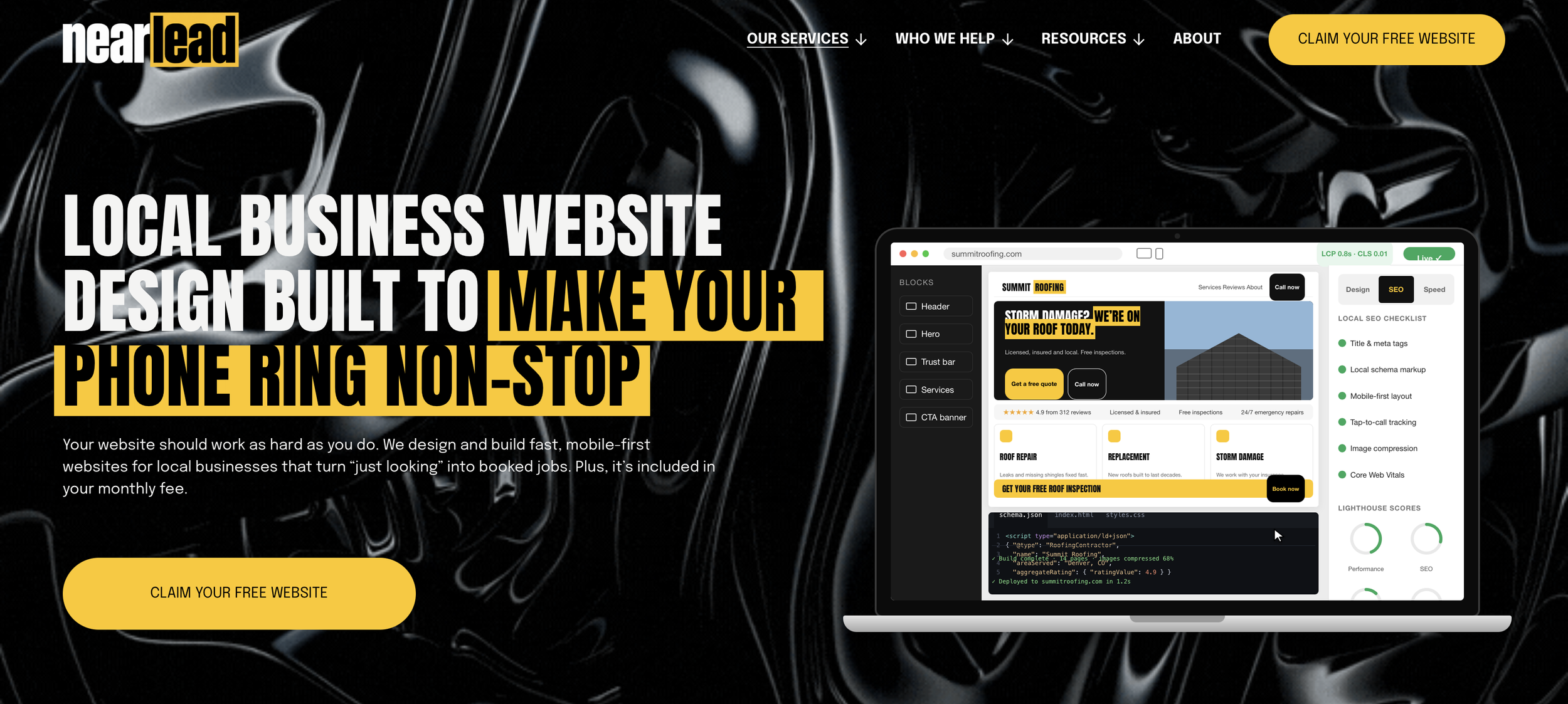
Worth considering for: Plumbing companies wanting a $3,500 one-time website purchase with the option to add ongoing marketing.
Nearlead offers website development alongside SEO, local SEO, AI search, search advertising and content marketing. Businesses can purchase the website as a standalone project or have it included at no additional cost with a marketing retainer.
For a plumbing business, the brief should begin with the services and service areas that matter commercially. Drain cleaning, water heater installation, leak detection and commercial maintenance each need different information. A website should help customers identify the right service and understand how to contact the team.
Pricing and Value
Nearlead's website price is $3,500 as a one-time fee, or included at no additional cost with a marketing retainer.
That gives businesses a clear project price to compare with other proposals. The retainer option still involves paid marketing services, so assess the total commitment rather than treating it as a free standalone website.
Agree on the sitemap, copywriting, revisions, integrations and launch responsibilities before work begins. Hosting, maintenance and ongoing changes should also be defined in the proposal.
Available Client Evidence
For a local-business engagement, Nearlead reports:
64% growth in relevant traffic.
147% more leads.
Website conversion rate increasing from 6% to more than 19%.
Cost per lead declining from $45 to $24.
The comparison uses matching three-month periods year over year to account for seasonality. These are supplied, agency-reported figures from a wider marketing engagement. They do not establish what website design alone achieved or predict the results of a new project.
Before signing: Confirm exactly what the $3,500 package includes, who owns the finished website and how contact forms, calls and booking requests will be tracked. For the retainer route, request the full fee schedule and cancellation terms.
2. Hook Agency
Worth considering for: Plumbing companies seeking website design together with ongoing search marketing.
Hook Agency has a dedicated plumbing web design offering and a wider focus on home services. Its plumbing page includes contractor branding examples, including Bears Plumbing Services.
Hook lists two website routes: a standard site built on its contractor code base and a custom build. The standard option is $12,000 across 12 monthly payments and is available only with a recurring service. The listed custom arrangement is $24,000 across 12 months when paired with recurring service.
Include the separate service fees when comparing these figures with a standalone website purchase. Hook's pricing page states that clients own their websites and receive training.
Before signing: Ask which parts of the design are bespoke, what content is included and how much the complete first-year engagement costs. Request live plumbing examples showing the mobile contact journey.
Sources: Plumbing website design · Pricing.
3. RYNO Strategic Solutions / Blue Corona
Worth considering for: Plumbing businesses wanting a managed website with wider home services marketing support.
RYNO's website offering includes custom design, WordPress development, hosting, maintenance and security support. Its dedicated plumbing marketing service connects website work with search optimization and other acquisition channels.
This may suit a company that wants one provider to manage both the website and the ongoing work around it. The proposal still needs to distinguish the initial build from recurring services and software charges.
Blue Corona and RYNO have merged. They are listed together here so readers do not mistake them for two independent choices.
Pricing: Request a custom proposal specifying the website project and any required monthly services separately.
Before signing: Confirm the contracting entity, delivery team, site ownership and transfer process. Ask how reporting distinguishes a lead from a booked service call and a completed job.
Sources: Website design · Plumbing marketing · Blue Corona relationship.
4. KickCharge Creative
Worth considering for: Plumbing companies making a broader investment in brand identity and website presentation.
KickCharge combines branding and website services for home service businesses. Its website service includes design, writing and development, with ongoing management available. Its portfolio material includes examples for Peacock Plumbing and Wiegand Plumbing.
The agency describes responsive websites and provides a recorded training session so clients can make changes. Its broader branding focus makes it worth considering when the website must align with a new logo, vehicle graphics and other customer-facing materials.
Pricing: Request a custom proposal. Establish whether brand development is included, optional or a prerequisite for your project.
Before signing: Ask for examples at a similar budget and confirm which assets you receive. If a rebrand is involved, assign responsibility for updating the website, business profiles and existing marketing materials consistently.
Sources: Website services · Website examples and broader offering.
5. Plumbing Webmasters

Worth considering for: Plumbers wanting a niche-specific website within an ongoing search marketing service.
Plumbing Webmasters builds WordPress websites for plumbing companies. Its design service describes service-page structure, local relevance, internal linking, mobile contact forms, click-to-call functionality and performance optimization.
Its monthly plan combines website design with SEO, local optimization, reporting, updates and access to its DataPins software. The agency advertises month-to-month agreements.
That structure is different from purchasing a website outright. A flexible marketing agreement does not, by itself, answer whether every website feature transfers when the service ends.
Pricing: Request the full monthly fee, any setup charges and the minimum amount payable before launch.
Before signing: Establish ownership of the site and content, hosting arrangements and what happens to DataPins features on cancellation. Ask to inspect live client websites as well as portfolio screenshots.
Sources: Website design · Monthly service offering.
6. Slamdot
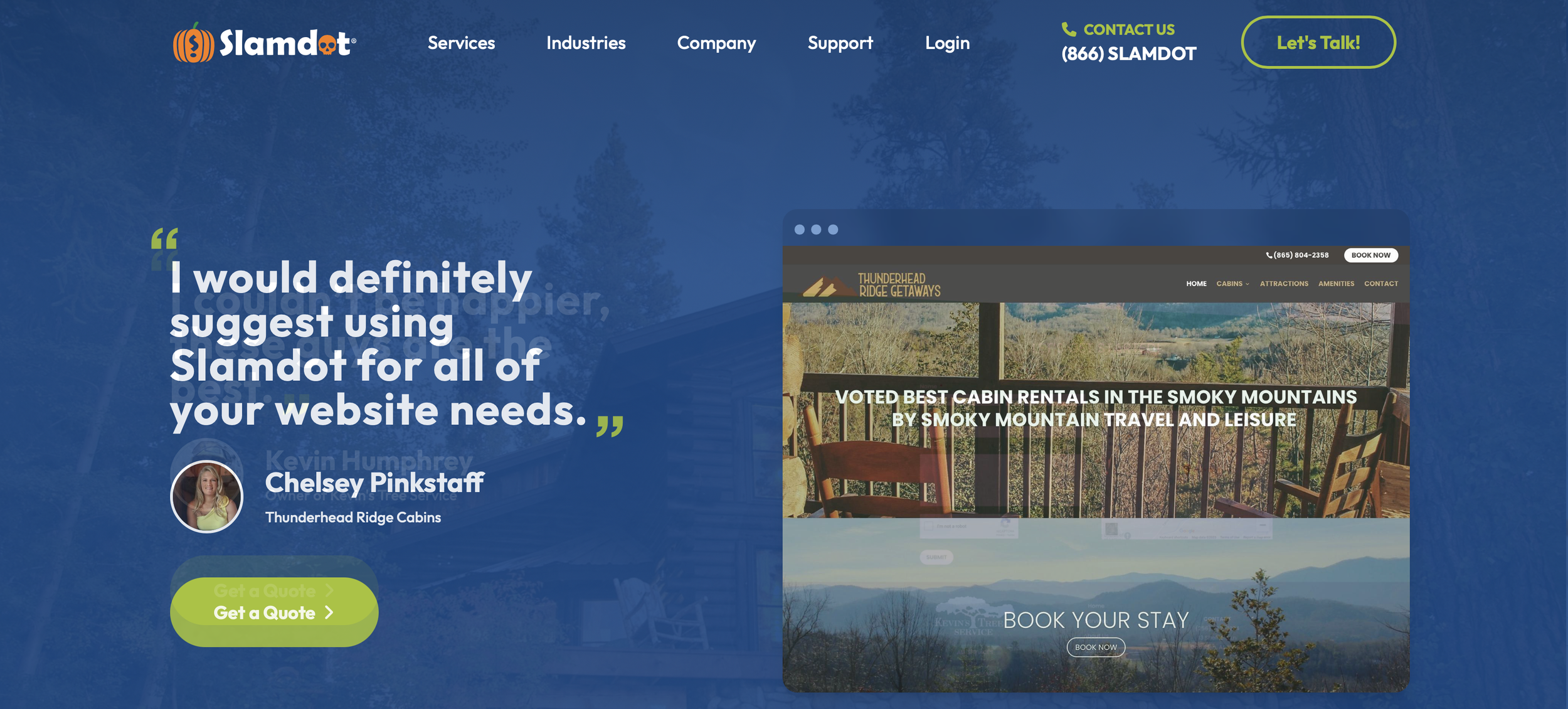
Worth considering for: Smaller plumbing businesses seeking a defined WordPress project and straightforward editing options.
Slamdot offers WordPress website packages and a dedicated plumbing service page. Its plumbing material includes a named testimonial from Lawrence Plumbing LLC about a website redesign and launch.
The web design process includes a consultation, fixed-rate quote, mockup approval, development and training. Published packages range from a single landing page to larger builds. The agency states that clients own their websites and can use another hosting provider.
Content responsibilities deserve attention. Its standard process asks clients to supply text and photographs; writing assistance can involve an additional fee.
Pricing: Request a fixed-rate quote for the page count and functionality you need.
Before signing: Clarify the level of customization, copywriting, hosting and maintenance. Ask the team to show how you would change service information, upload project photos and update business hours after launch.
Sources: Plumbing services and testimonial · Web design process and ownership.
7. Leadhub
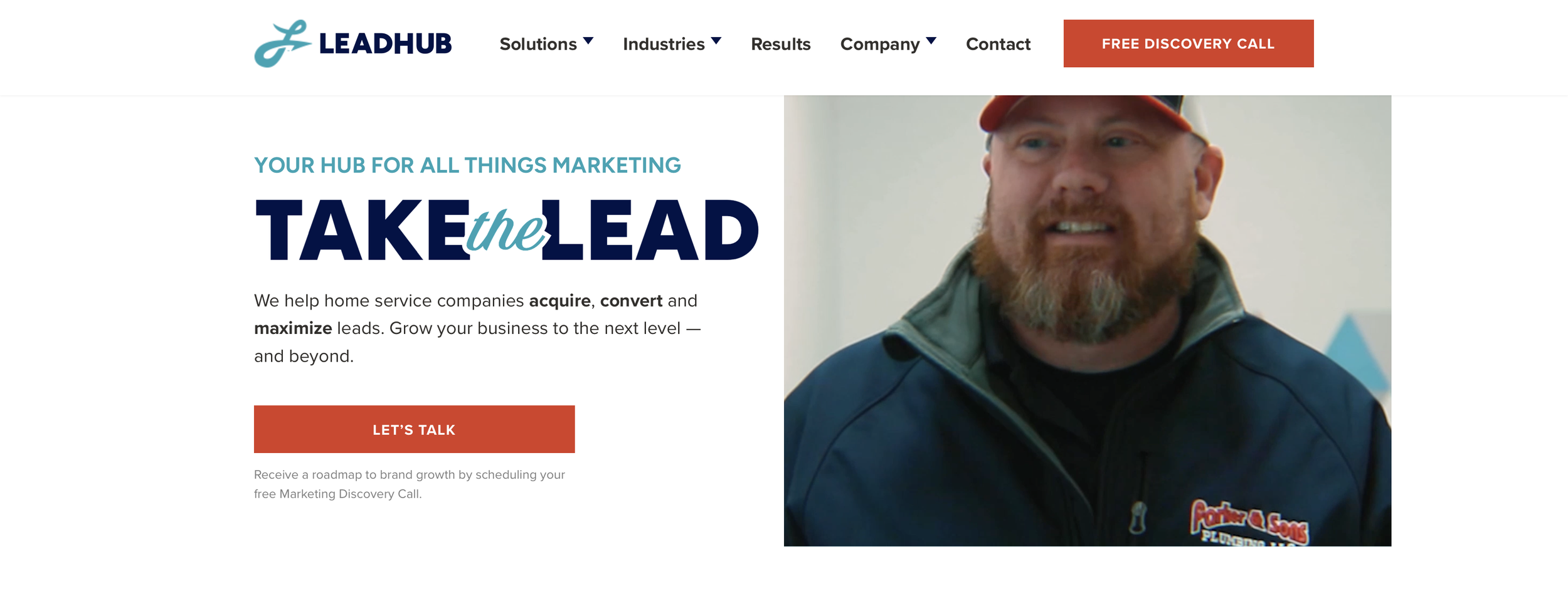
Worth considering for: Plumbing and other trade businesses connecting website development with broader marketing activity.
Leadhub's development service emphasizes clear navigation, mobile usability, website security and industry-specific integrations. Its page also references Parker and Sons Plumbing, providing a relevant named business example.
The practical question is how those capabilities would work with your intake process. A request form, a live booking calendar and a field-service integration have different requirements. Ask for a demonstration using the type of workflow your office actually needs.
Pricing: Request a custom proposal separating the website build, ongoing marketing and third-party software costs.
Before signing: Confirm the platform, content responsibilities and support arrangements. Ask which integrations have been implemented for comparable businesses and who investigates a failed booking or missing lead.
Source: Web development for the trades.
8. Scorpion
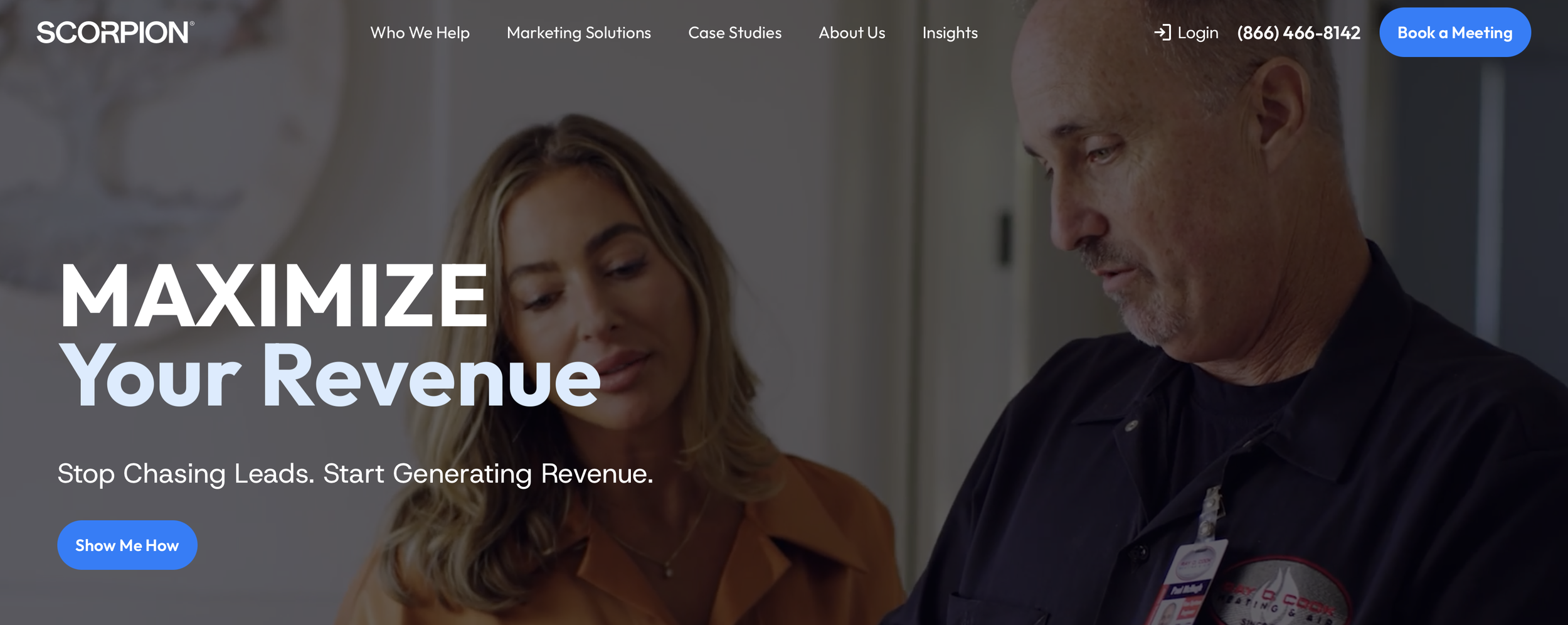
Worth considering for: Plumbing businesses wanting a website connected with customer communication and lead tracking technology.
Scorpion's plumbing website offering describes online appointment requests or booking, call tracking and lead analysis. It also promotes Scorpion Connect for AI-assisted customer communication, including questions, appointment booking and payments.
These capabilities make the operating setup as important as the design. Establish which features are included in your package, which require additional subscriptions and how the system hands an inquiry to your staff.
Pricing: Request a custom proposal covering the website, technology, marketing services and any advertising budget separately.
Before signing: Test urgent and routine inquiries in a demonstration. Confirm how unavailable appointments, out-of-area callers and human handoffs are handled. Ask what website assets, customer data and reporting history can be exported if you leave.
Source: Plumbing website design and management.
9. Thrive Internet Marketing Agency
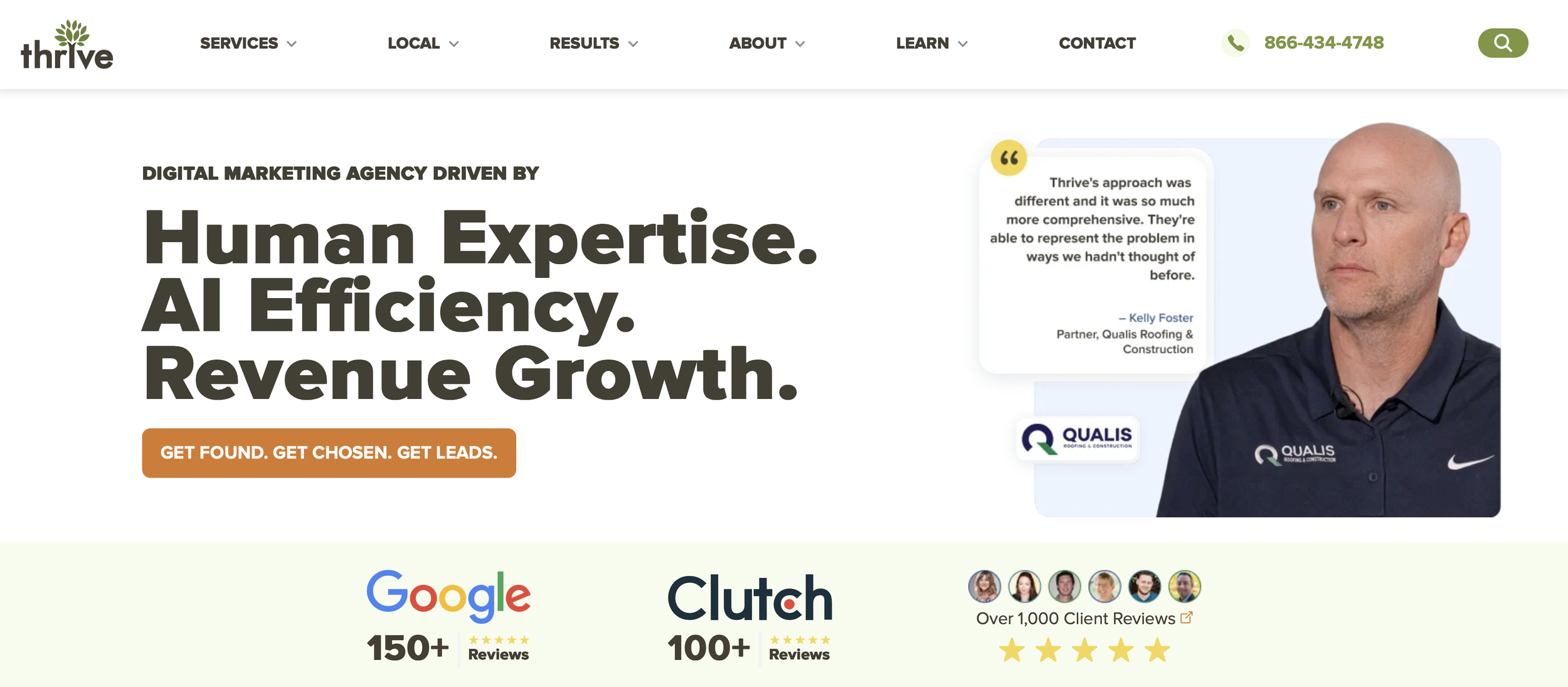
Worth considering for: Plumbing companies seeking website work alongside SEO, content and conversion optimization.
Thrive has a dedicated plumber web design offering and named plumbing case studies. Its In-House Plumbing Company case study covers website design and SEO. Its Accurate Leak and Line case study describes website testing intended to improve conversions.
These examples give prospective clients relevant projects to discuss. They should not be treated as evidence that a visual redesign alone produced every outcome associated with a wider campaign.
Pricing: Request a custom proposal for your website scope and any ongoing services.
Before signing: Ask which team will handle the project, whether content is included and how existing rankings will be protected during migration. Request a reporting example that separates website inquiries from qualified and completed jobs.
Sources: Plumber web design · In-House Plumbing Company · Accurate Leak and Line.
10. WebFX
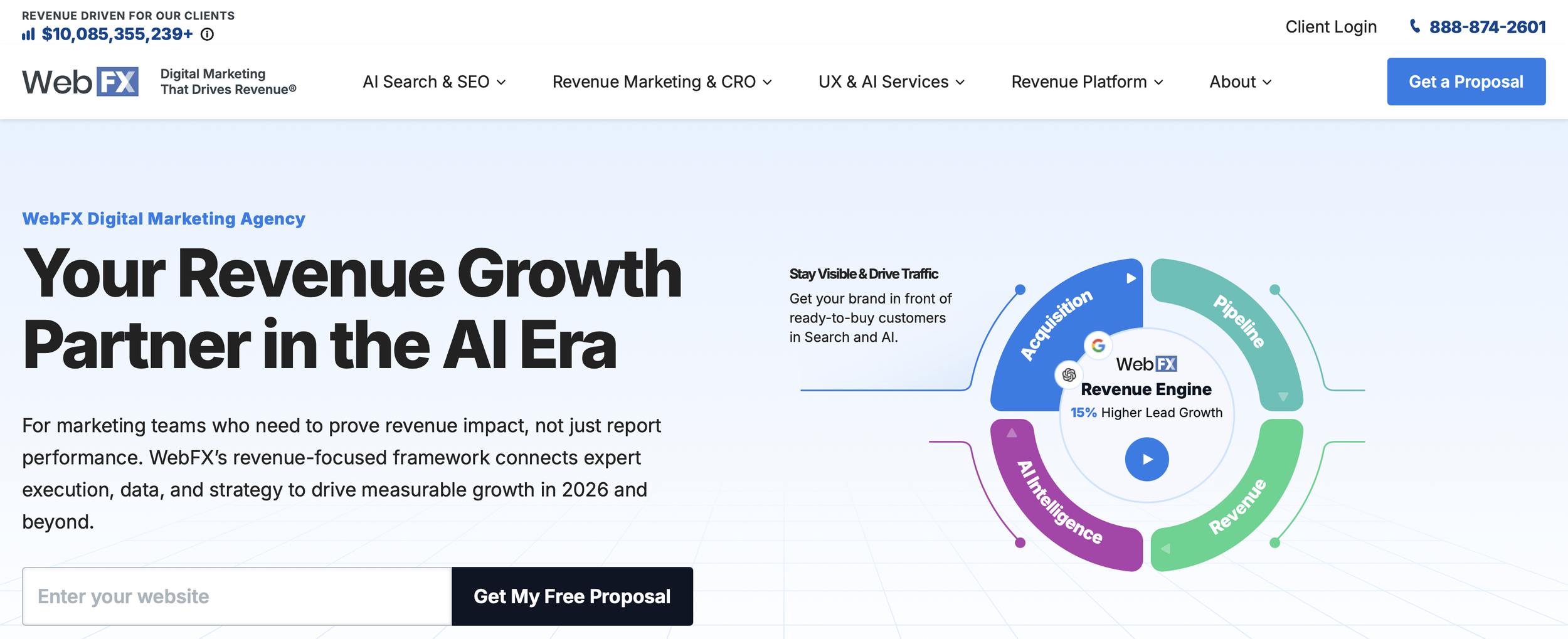
Worth considering for: Plumbing businesses needing custom development and access to a broader digital marketing team.
WebFX offers responsive website design, content creation, redesigns and ongoing optimization. It also publishes a plumbing-specific web design guide describing its services for the industry.
Its general custom website service starts at $8,000 per site. Functionality, project timing and marketing requirements affect the quote. This starting price should not be interpreted as a fixed package for every plumbing business.
For a larger project, prepare a written scope covering service areas, page types, booking tools and reporting requirements before requesting a proposal.
Before signing: Request comparable plumbing work from the proposed delivery team. Confirm the content migration plan, editing access and which services continue after the website is launched.
Sources: Website services and pricing · Web design for plumbers.
Which Agency Fits Different Plumbing Companies?
| Your priority | Options to compare | What to establish |
|---|---|---|
| A clearly priced standalone website | Nearlead, Slamdot | Page scope, writing, ownership and ongoing costs |
| Website design with recurring search marketing | Hook Agency, Plumbing Webmasters | Required monthly services and total commitment |
| Website and brand identity together | KickCharge Creative | Branding deliverables and rollout responsibilities |
| Managed home services website and marketing | RYNO, Leadhub | Delivery team, integrations and lead reporting |
| Booking and communication technology | Scorpion | Subscription costs, human handoffs and data portability |
| Broader development and marketing requirements | Thrive, WebFX | Comparable projects and the assigned team's experience |
Use the table to narrow your shortlist, then give each agency the same brief. Comparable proposals are more useful than ten different interpretations of what your business needs.
What Should the Best Plumber Websites Include?
Clear Emergency and Routine Contact Options
Place a working phone number where mobile visitors can find it quickly. Use a clear label such as “Call for Plumbing Service” and make the number tappable.
Keep clear contact information in the header and footer, and provide an obvious emergency service button where that service is available. Someone facing an urgent plumbing issue may be worried about damage and looking for immediate help. Give them key information without making them search through several pages.
Distinguish immediate assistance from routine scheduling. If you only answer calls during business hours, state that. If you offer emergency service, explain the actual coverage and response process without promising arrival times your team cannot reliably meet.
A general contact form should not look like a confirmed appointment. Tell customers whether they are requesting a callback, asking for an estimate or reserving an available slot.
If you advertise same day service, state the booking cutoff, coverage and availability conditions alongside the offer. Clear expectations help potential clients decide whether your service fits their situation.
Dedicated Pages for Your Plumbing Services
A useful sitemap reflects the work you perform. Depending on your business, it may include drain cleaning, water heater repair, tankless installation, sewer repair, leak detection, fixture installation and commercial plumbing.
Each page should answer the questions relevant to that service: what problems you handle, what the visit involves, where you work and how customers can arrange help.
Avoid making a single page carry every service description. Equally, do not create dozens of near-identical pages simply to increase the page count. Give each page a distinct purpose.
Plumbing and Air Conditioning Services Need Clear Navigation
For businesses offering plumbing, heating and air conditioning, separate the main service categories in the navigation bar. A customer with a blocked drain should not have to work through cooling installation information to find help.
Use a clean layout with descriptive labels and a consistent colour scheme. Keep the main action easy to recognize, and remove decorative elements that compete with it. Minimalist design can be useful, but the priority is whether visitors can find the service, coverage and contact route they need.
Accurate Service Areas and Local Business Information
Show the towns, neighborhoods or ZIP codes you genuinely serve. A service area map can help customers check coverage, but include readable location information as well.
For example, a business serving the Phoenix area should distinguish its actual coverage from a vague claim to serve all of Arizona. Location pages should help customers check availability and see relevant work, not simply repeat the same text with different city names.
Keep your company name, phone number and business hours consistent across the website and Google Business Profile. Google's guidance identifies relevance, distance and prominence or popularity as the main local ranking considerations. A website cannot remove the distance factor or guarantee a map position.
Source: Google's local ranking guidance.
Customer Reviews That Build Confidence
Show authentic customer reviews with their source and enough context to be useful. Include real team and vehicle photographs where possible, and explain your experience with the services being promoted.
Specific comments about communication, punctuality or a completed repair give new visitors more context than star ratings alone. If you use a reviews carousel, make it easy to control and ensure important feedback remains accessible on mobile devices. Customer evidence builds trust when readers can understand who is reviewing the business and what work was done.
Displaying reviews does not guarantee review stars in Google search results. Google's rules exclude self-serving reviews of a LocalBusiness or Organization from review-rich-result eligibility, including reviews embedded through third-party widgets. Do not choose an agency on the promise that adding review schema will automatically produce stars or a fixed click-through-rate increase.
Source: Google's review snippet guidelines.
Accurate license information, insurance details, workmanship commitments and warranty terms can help customers evaluate the business. Make important conditions easy to find rather than relying on unexplained badges.
Before and After Photos That Show Your Work
Before and after photos are useful when they show an understandable result. Add a short caption describing the work. Real photos of technicians, vehicles and completed installations provide evidence that generic stock photos cannot supply.
Use original photos with permission, keep customer details private and choose real images that clearly show the finished work. Quality matters more than a large gallery: sharp, well-lit photographs make the work easier to assess. Ask how your team can upload new photos without needing a developer for every update.
An explanation of the problem, solution and final checks is a nice touch that makes an image more informative. Claims of superior workmanship become more useful when supported by documented projects, clear warranties and customer feedback. There is no universal conversion multiplier you should assume simply because original photography replaces stock imagery.
An About Page That Introduces the People Behind the Business
An about page should explain who runs the company, how the team works and what customers can expect during a visit. Name the founder or co founder where relevant, include accurate experience and show the people customers may meet.
Professional team photos and a straightforward company story can create a site that feels welcoming. Avoid a cookie cutter biography that could describe any contractor. Specific details about training, local experience and customer care give readers a reason to remember the business.
Mobile-Friendly Design and Fast Loading
Review the site on a real phone before approving it. Check navigation, text size, form fields, buttons and whether floating chat or call widgets obscure the content.
Statcounter reported that mobile devices accounted for 58.99% of worldwide web page views in September 2026. This is a global measurement, not the mobile share of US plumbing searches. Use your own analytics to understand your customers, while ensuring the website works well across devices.
Source: Statcounter worldwide platform data.
Set performance expectations before development. Google's Core Web Vitals guidance recommends a Largest Contentful Paint within 2.5 seconds and an Interaction to Next Paint below 200 milliseconds. These measure loading and responsiveness; they are not a promise of a particular ranking.
Ask the agency to test important service pages as well as the homepage. Large images, video backgrounds and third-party tools should be assessed for their effect on the actual user experience.
Source: Google's Core Web Vitals guidance.
Forms and Booking Tools That Match Your Workflow
Keep the first inquiry focused on information your team needs to respond: name, contact details, service location and a short description of the problem. Additional questions can follow when they are relevant.
If the website accepts bookings, define the rules for travel zones, appointment duration and technician availability. Test where the information goes and what the customer receives afterward.
Include a fallback contact route when a tool fails. A booking widget should support customer service without becoming the only way to reach the business.
Live chat can capture inquiries outside regular business hours when it is staffed or configured to collect contact details. Explain whether visitors are speaking with a person or an automated assistant, and when they can expect a reply. A captured lead is not the same as an available technician.
Transparent Pricing and Clearly Explained Add Ons
Where practical, explain service-call fees, estimate policies and what affects the final price. If a job requires an inspection before a quote, say why. This gives prospective customers a clearer basis for comparing providers.
Optional add ons should have understandable descriptions and prices where available. Transparent pricing builds trust by reducing surprises; it does not require publishing an unrealistic fixed price for every possible repair.
What Plumbing Businesses Can Learn From Real Website Examples
The following businesses are reference examples for content and structure. Their inclusion does not imply a relationship with any agency in this guide, and no conversion uplift is attributed to their design.
Reliant Plumbing: Company Story and Service Detail
Reliant Plumbing's website includes an account of its origins, a description of its values and links to services and recent projects. Its about page identifies 2014 as the beginning of its service history and explains its Texas markets.
The useful lesson is to connect the business story with practical customer information. Readers can learn who the company is, explore the work it offers and find a contact route without relying on generic promotional claims.
Source: Reliant Plumbing's about page.
My Plumber Plus: Clear Service Positioning
My Plumber Plus states that it has served Northern Virginia and suburban Maryland since 1982. Its website brings plumbing, HVAC and electrical services together and presents a same-day service offer with stated conditions.
For a business with several trades, the lesson is to make both the service categories and offer conditions easy to find. An accurate operating history provides useful context without overstating how long the current company has existed.
Sources: My Plumber Plus · Company history.
Tony LaMartina Plumbing: Distinguish Family History From Company History
Tony LaMartina Plumbing describes family roots in the trade that began more than a century ago, while identifying 1982as the founding year of Tony's own company. Its history explains the generations behind that distinction.
This is a useful model for plumbing contractors with a long family background: give readers the dates and context rather than turning a family legacy into an inaccurate company age.
Source: Tony LaMartina Plumbing's company history.
American Plumbing Systems: Organize Commercial Project Evidence
American Plumbing Systems identifies its commercial and industrial focus, lists market sectors and provides named project examples with locations. That organization gives prospective clients a way to assess whether its work resembles their own requirements.
Use the example to brief an agency on project categories and relevant evidence. Separately, test the proposed site's color contrast and readability rather than assuming an attractive colour scheme is accessible.
Source: American Plumbing Systems.
How Much Does Plumbing Website Design Cost?
The offers in this guide use different pricing models. Nearlead lists a $3,500 one-time project. WebFX's general custom service starts at $8,000. Hook lists $12,000 standard and $24,000 custom website arrangements paid over 12 months, with recurring services attached. Other providers require a quote or bundle website work into a monthly plan.
These are examples from the reviewed providers, not an industry average. Different page counts, content needs and integrations can produce very different quotes.
Compare these cost categories:
| Cost | What to clarify |
|---|---|
| Design and development | Page types, templates, customization and revision rounds |
| Content | Copywriting, editing, photography and migration of existing pages |
| Hosting and maintenance | Updates, backups, security, support and restoration responsibilities |
| Booking and communications | Setup, recurring subscriptions, usage charges and integration support |
| Search optimization | What is included at launch and what requires ongoing work |
| Advertising | Management charges and media spend as separate figures |
| Ownership and exit | Export costs, transfer assistance and continuing software dependencies |
Ask for the total first-year cost and the expected second-year cost. This exposes the difference between a website installment that ends and a subscription that continues.
How to Measure More Leads and Booked Jobs
Establish a baseline before launch. Record existing organic traffic, qualified inquiries, booked jobs and the services those jobs involve.
An agency may use content, local search optimization and advertising to drive traffic, but the commercial test is what happens next. Track whether those visits produce relevant inquiries and whether your team can turn them into paying customers.
After launch, monitor the full customer journey:
| Measure | Why it matters |
|---|---|
| Relevant website visits | Shows whether the site attracts people in your market |
| Completed forms and connected calls | Measures actual inquiries rather than button clicks alone |
| Qualified leads | Excludes spam, suppliers and requests you cannot serve |
| Booked jobs | Connects marketing activity with your schedule |
| Completed jobs and collected revenue | Helps assess commercial value |
| Missed calls and response times | Identifies operational problems that design cannot fix alone |
Compare equivalent periods where possible. Weather, staffing, advertising budgets and service-area changes can affect results independently of the website.
A higher conversion rate is useful only if the inquiries are relevant. Ten qualified water heater installation requests may have a different value from ten calls about services you do not offer.
Questions Plumbing Contractors Should Ask Before Hiring an Agency
Can you show comparable live websites? Review the mobile experience and contact process yourself.
What is included in the price? Request page counts, writing responsibilities and revision limits.
Who owns the domain, website and content? Get transfer rights in writing.
Which recurring services are mandatory? Separate optional support from required commitments.
How will you handle the existing website? Ask for a page inventory, migration plan and redirect responsibilities.
How do inquiries reach our team? Test forms, calls and bookings before launch.
What will you report? Ask for qualified leads and booked jobs alongside traffic and rankings.
What happens after launch? Define support, updates, backups and response expectations.
The strongest proposal makes delivery responsibilities clear enough that both sides know what a successful launch looks like.
Can a Plumbing Website Help With AI Search Visibility?
A clear, accessible website gives search systems information about your business, services and service areas. Useful service descriptions, accurate contact details and documented project experience can make that information easier to understand.
Google states that existing SEO best practices remain relevant to AI Overviews and AI Mode, with no additional technical requirements or special optimization required for those features. That guidance applies to Google's systems; other platforms have their own retrieval behavior.
Ask an agency to explain its proposed AI search work in concrete terms: improving content, checking crawler access, correcting business information or monitoring citations. A promise to make your company appear in every AI answer is not a measurable website deliverable.
Track relevant mentions and referrals where observable, alongside normal search and lead reporting. A mention is an exposure signal; it is not automatically a customer inquiry.
Source: Google's guidance on AI features and websites.
Frequently Asked Questions
What Does a Plumbing Website Design Agency Do?
A plumbing website design agency plans and builds the pages, content and contact features that help customers understand your services and request work. Depending on the agreement, it may also handle hosting, SEO, booking integrations, maintenance and ongoing marketing. Confirm which services are included in the website project.
Is a Plumbing Specialist Better Than a General Web Design Agency?
A specialist may understand service areas, emergency inquiries and plumbing terminology more quickly. A generalist may bring broader development or design capabilities. Compare the assigned team's relevant work, proposed approach and ability to support your actual workflow.
How Much Does Nearlead Charge for a Plumbing Website?
Nearlead's website offer is $3,500 as a one-time fee, or included at no additional cost with a marketing retainer. Confirm the page scope, content, integrations and ongoing costs in the proposal. The retainer itself is a paid service.
Do Plumbing Websites Need Local SEO?
Local SEO is useful when your business relies on customers within a defined service area. The website should explain your services and coverage clearly, supported by accurate business information and useful local content. Design alone does not guarantee visibility in search results.
Can We Keep Our Existing Domain and Phone Number?
Make this part of the project brief. Confirm that your business controls the domain account and that any call-tracking setup preserves the underlying number and routing arrangements. If email uses the same domain, include email continuity in the launch checklist.
Can We Keep the Website If We Change Agencies?
That depends on the contract and platform. Clarify whether you receive a transferable website, access to its source files and database, or only an export of content. Ask which plugins, booking features or reporting tools require an ongoing subscription.
Should Our Website Include Online Booking?
Online booking can be useful when it reflects real availability and service-area rules. If your office must assess the job before assigning a technician, an appointment request may be more appropriate. Label the action clearly so customers know whether their time slot is confirmed.
How Many Pages Does a Plumbing Website Need?
There is no universal minimum that guarantees SEO results. Plan pages around distinct services, genuine locations and customer questions. A focused site with useful information is a better starting point than a larger site filled with repetitive pages.
Is a Custom Website Always Better Than a Template?
No. A well-configured framework can support a clear, fast and effective website. Custom development may be justified by branding, complex integrations or unusual content requirements. Judge the finished experience, editing flexibility and ownership terms rather than the label alone.
How Long Does It Take to Build a Plumbing Website?
The timeline depends on page count, content readiness, integrations and approvals. Request milestones for planning, design review, development, testing and launch. Ask what information your team must provide and how delays affect the schedule.
Will a Website Redesign Improve Rankings Immediately?
Not necessarily. A redesign changes pages and technical elements that search engines need to process. Preserve useful existing content, plan redirects and monitor indexing and lead delivery after launch. Assess performance over an appropriate period rather than promising immediate gains.
What Should We Check Before the Website Goes Live?
Test the phone links, inquiry forms, booking tools, confirmation messages and routing to your team. Review mobile layouts, service information, redirects, tracking and editing access. Make sure launch does not interrupt existing email or customer communications.
Ready to Plan Your Plumbing Website?
Choose an agency that can explain how its website will support your services, service areas and customer response process. Compare the full scope and ongoing commitments alongside the design examples.
For a clearly priced starting point, Nearlead offers a website for $3,500 as a one-time fee, or includes it at no additional cost with a marketing retainer. Request a proposal built around the services you want to promote and the inquiries your team is ready to handle.
“You bring the business, we’ll bring the marketing. Together, we’d be unstoppable.”
