
Related Posts


A chiropractic website needs to answer a few questions quickly: What does this practice offer? Who will I see? What should I expect on my first visit? And how do I book?
The right website design company should make those answers easy to find while giving your team a practical way to manage appointment requests. A polished homepage is only one part of the project. Service pages, practitioner profiles, mobile usability, content and the booking process all affect whether visitors take the next step.
For a clinic owner, a strong online presence should reflect the practice behind it. Someone comparing chiropractors for the first time needs different information from an existing patient looking for your hours or intake forms. Your website should serve both without making either journey complicated.
This guide compares ten chiropractor website design companies and providers serving the US market, including NearLead, Perfect Patients, Inception and CHIROBASIX. We examine their services, published pricing, available evidence and the questions worth asking before signing.
Information checked October 30, 2026, for 2027 planning. Published prices may change. This guide is published by NearLead and includes our services; placements reflect our editorial assessment of fit and value.
COMPARE THE BEST CHIROPRACTOR WEBSITE DESIGN COMPANIES
Some companies build standalone websites. Others provide a managed website subscription or include the build in an ongoing marketing agreement. Compare the complete scope and commitment before comparing headline prices.
| Agency | Worth considering for | Website pricing or engagement model | What to clarify |
|---|---|---|---|
| 1. NearLead | A defined website project with the flexibility to add ongoing marketing | $3,500 one-time website fee, or a website included at no additional build cost with its marketing retainer | Pages, content, platform, ownership, hosting and support |
| 2. Perfect Patients | Practices wanting a managed chiropractic website and ongoing content support | Plan-based service; request pricing | Plan inclusions, original content and transfer arrangements |
| 3. Inception | Chiropractic websites connected with local search and patient communication | Custom proposal | Build scope, intake tools and ongoing service commitments |
| 4. CHIROBASIX | Practices wanting a published website subscription price | Website-only program at $150/month; no setup fee | One-year website term, ownership and optional marketing costs |
| 5. Rocket Chiro | Solo and smaller practices wanting direct support or a standalone build | Standard service $150/month plus $400 setup; custom builds typically $5,000–$6,000 | Subscription versus standalone ownership, hosting and support |
| 6. ChiroCandy Marketing | Practices connecting a custom website with advertising and follow-up | Website service $350/month with a 12-month website agreement | Applicable setup fees, ownership and separately purchased marketing |
| 7. Harris & Ward | Practices wanting website design with original photography and video | Scoped proposal | Production, travel, copywriting and post-launch services |
| 8. ChiroMatrix by iMatrix | Practices seeking a website platform with education and marketing tools | Plan-based proposal | Customization, content, integrations and platform dependencies |
| 9. ChiroHosting | Practices seeking a lower-cost website platform with upgrade options | Launch plan approximately $65/month; higher tiers available | Included design work, subscription features and export options |
| 10. Thrive Internet Marketing Agency | Website design, content and hosting through a broader digital agency | Custom proposal | Relevant examples, development scope and ongoing marketing fees |
Prices are in USD. NearLead’s marketing retainer is $3,500 per month, excluding advertising spend, with $0 initiation and an initial 12-month commitment, followed by month-to-month service. That is a separate purchasing option from its one-time website project. Sources for competitor offerings are linked in the profiles below.
HOW WE SELECTED THESE CHIROPRACTIC WEB DESIGN COMPANIES
We reviewed public website service pages, pricing, portfolios and available client examples. The shortlist includes chiropractic specialists, website platforms and broader agencies with relevant offerings or local market experience.
Our assessment considered:
Website scope: Design, development, content, mobile layouts and support for service, practitioner and location pages.
Patient journey: How visitors learn about the practice, contact the team and request an appointment.
Search and migration: How the provider addresses discoverability and existing website assets during a rebuild.
Commercial clarity: Pricing, recurring requirements, ownership, maintenance and cancellation provisions.
Growth flexibility: Whether the website can support additional services, clinicians, locations and marketing channels.
Evidence quality: Whether published results relate to website changes, SEO or a broader marketing program.
The best choice depends on what your practice needs next. A straightforward website launch, a replacement for an underperforming site and a multi-location redesign are different projects.
1. NEARLEAD
Worth considering for: Chiropractic practices wanting a clearly priced website project with a practical path to ongoing growth.
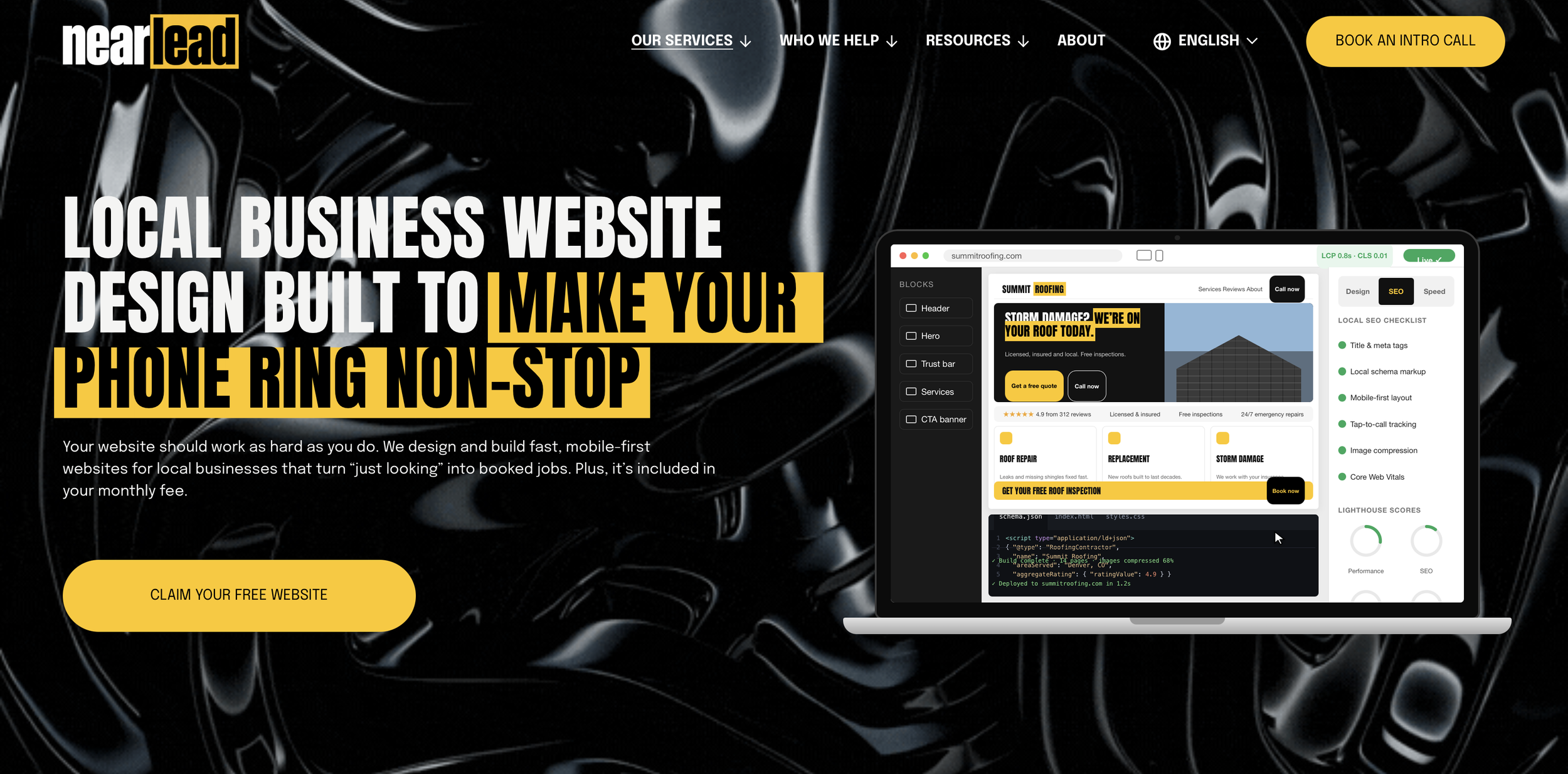
NearLead combines website development with local market experience in search visibility, lead generation and conversion improvement. Its website-only offer is a $3,500 one-time project, with ongoing marketing available separately.
That flexibility is a useful starting point for a practice that wants a better website without immediately committing to a wider marketing program. It also gives an expanding clinic the option to coordinate its website, SEO, local SEO, AI search, search advertising and social media management through one provider.
For a chiropractic practice, the opportunity is to plan the website around both patient questions and business goals. Practitioner profiles can explain who patients will meet. Service pages can describe what the clinic offers. Location information and clear calls to action can help visitors move from research to an appointment request.
NearLead’s appeal is the connection between the initial website project and the acquisition work that may follow. A practice can start with the build, then add the channels that fit its capacity and growth plans.
PRICING AND VALUE
One-time website package: $3,500.
Alternatively, the website is included at no additional build cost with NearLead’s $3,500-per-month marketing retainer. The retainer has $0 initiation, an initial 12-month commitment, and month-to-month service thereafter. Advertising spend, client CRM and additional conversion technology are separate.
The choice makes the offer worth considering for two different situations: a clinic seeking a defined website project and a practice ready to invest in a coordinated marketing program. Select the option around the work you need, with the proposal spelling out pages, copy, revisions, integrations, hosting and support.
AVAILABLE CLIENT EVIDENCE
NearLead’s local market experience includes an engagement with a local business in Austin, Texas. Agency-reported results include:
64% growth in relevant traffic.
147% more leads.
Conversion rate increased from 6% to more than 19%.
Cost per lead declining from $45 to $24.
The campaign also achieved consistent top-three positions for tracked high-intent Google searches and AI search prompts. The reported comparisons use matching three-month periods year over year to help account for seasonality.
These results illustrate NearLead’s local market approach to acquisition and conversion. They reflect the wider campaign rather than an isolated measurement of website design.
Before signing: Agree on the sitemap, original content, platform, revisions, ownership and launch process. Confirm any ongoing costs and how appointment inquiries will reach your team.
2. PERFECT PATIENTS
Worth considering for: Practices wanting a managed chiropractic website with ongoing content and marketing support.

Perfect Patients offers chiropractic website design through Essential, Premium and Ultimate service plans. Its published scope includes custom design and copywriting, local SEO planning and ongoing services, with features varying by plan.
The managed model may suit a clinic that prefers continuing website support and content delivery. Ask to see the specific design and service level you would receive, including how much of the content is unique to your practice.
The plans page directs prospective clients to request pricing. Compare setup, monthly service and optional advertising costs separately.
Website portability deserves attention. Its support material explains that cancellation can require a new website design and separate hosting, so clarify the assets and rights available under your agreement.
Before signing: Request the full plan scope, editing arrangements, content rights and a written explanation of what happens to the website if the service ends.
Sources: Plans and website services · Ownership and cancellation FAQs.
3. INCEPTION
Worth considering for: Practices wanting a chiropractic website connected with local search and patient communication.

Inception offers chiropractic websites alongside Google advertising, social advertising and patient engagement tools. Its published examples provide a starting point for assessing how it presents different practice identities and services.
Its Hassig Chiropractic case study describes a website revamp, mobile improvements, local search work and online intake. Inception reports eight to fifteen new patient leads per month from organic search and time savings from digital intake forms.
Those outcomes reflect several changes across the marketing and administrative process. They are useful discussion points, but they do not isolate the effect of the redesign.
Pricing requires a current proposal covering the website and any ongoing services.
Before signing: Ask for a comparable website walkthrough and identify which intake, engagement and reporting features are included, optional or dependent on third-party software.
Sources: Chiropractic services · Hassig Chiropractic case study.
4. CHIROBASIX
Worth considering for: Practices seeking a chiropractic-focused website subscription with published pricing.

CHIROBASIX lists its website-only program at $150 per month, with no setup fee and a one-year website term. The published scope includes custom design, copywriting, mobile development, hosting, security, backups and ongoing updates.
The agency also lists lead forms and online booking or appointment requests. Establish whether that means linking to existing software, embedding a tool or developing an integration.
Its pricing page states that website ownership transfers after the one-year term. Its ENGAGE CRM and advertising services are outside the website-only plan.
This can be worth considering when a practice prefers a recurring website arrangement. Compare the ongoing service and exit provisions with the cost of a standalone project.
Before signing: Confirm page count, original copy, update allowances, domain costs and the practical transfer process after the website term.
Source: Website program, inclusions and ownership.
5. ROCKET CHIRO
Worth considering for: Solo and smaller practices wanting direct website support or a separately owned custom build.

Rocket Chiro emphasizes websites built and managed by a former practicing chiropractor. Its website page includes examples and describes a process shaped around the way each practice operates.
The standard website service is listed at $150 per month, with a $400 setup fee, and includes hosting and support. The same page describes standalone custom builds, intended for ownership and self-hosting, as typically costing 5,000–6,000.
That distinction is helpful: a managed subscription and an independently hosted website are different purchases. Ask which model best matches the control and ongoing assistance you want.
Local SEO and advertising services are also available, with scope and fees to confirm separately.
Before signing: Establish the content and design included in your chosen model, who hosts the finished site and what support remains available after launch.
Source: Website examples, pricing and project options.
6. CHIROCANDY MARKETING
Worth considering for: Practices wanting a custom website connected with advertising and lead follow-up.

ChiroCandy lists custom website services at $350 per month, with a 12-month website agreement. It also includes a custom website in its $2,290-per-month Advertising + Search Growth package, alongside advertising management and search optimization.
Its pricing page lists a typical $1,000 setup fee. Confirm the setup charge applicable to a website-only purchase. Advertising spend and applicable usage charges are additional to marketing service fees.
The broader offering may suit a practice planning to use paid campaigns and follow-up tools immediately. A website-only buyer should compare the narrower scope and full commitment.
When reviewing campaign examples, ask which results came through the website rather than through platform lead forms or other channels.
Before signing: Confirm the website deliverables, ownership, setup charges and what happens after the initial agreement. Ask which tools remain functional if marketing services end.
Source: Website and marketing pricing.
7. HARRIS & WARD
Worth considering for: Practices wanting original photography and video alongside website design.

Harris & Ward provides website design, branding, photography, video and digital marketing. Its portfolio lists chiropractic projects including MOOV Chiropractic & Training, Innovative Nerve & Joint Centers and Wellington Family Chiropractic.
The published work describes websites with features such as condition pages, patient forms and online scheduling. Those examples are useful for evaluating how the agency presents different practice models.
Original imagery may be particularly relevant when your current site says little about the people and environment patients will encounter. Ask how production, design and content planning work together.
Request a scoped website proposal. General marketing starting prices should not be interpreted as a complete website production budget.
Before signing: Clarify photography and video deliverables, travel, usage rights, copywriting and ongoing updates. Review the actual patient journey in comparable projects.
Sources: Portfolio and chiropractic projects · Services.
8. CHIROMATRIX BY IMATRIX
Worth considering for: Practices wanting a website platform with patient education and optional marketing tools.

ChiroMatrix is iMatrix’s chiropractic offering. Its website services include design options for different practice types, while its broader platform offers patient education, online booking and marketing features.
The website page describes a reporting portal for website visits and leads. Its West Hartford Chiropractic example discusses website improvements and custom content to present the practice’s specialties.
The platform approach may suit a clinic that wants several website and communication functions through one provider. Ask how much design customization and original writing are included in the proposed tier.
Request website-specific pricing rather than assuming a general entry-level marketing price covers your full requirements.
Before signing: Clarify editing access, integration options, reporting definitions and what can move to another platform if your requirements change.
Sources: Website services · Chiropractic website example.
9. CHIROHOSTING
Worth considering for: Practices seeking a lower-cost website platform with ready-made tools and upgrade options.
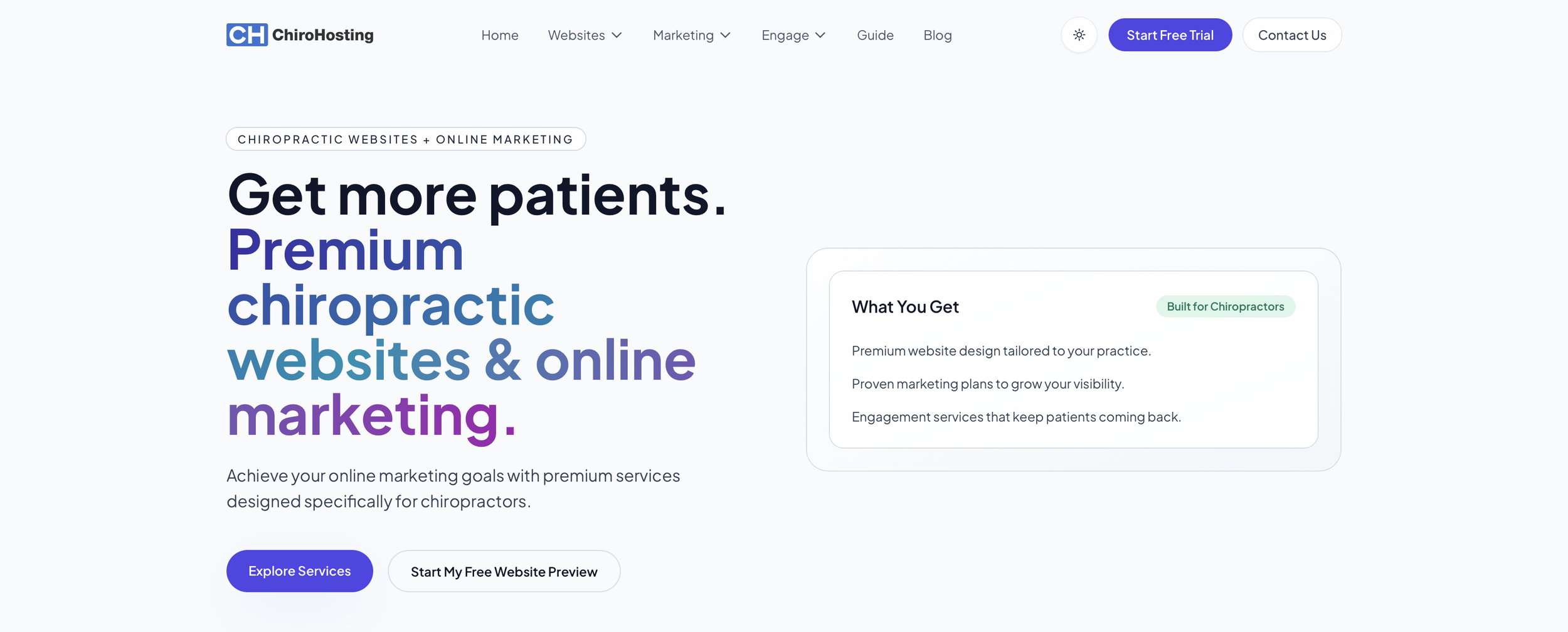
ChiroHosting’s N8 platform includes chiropractic content, patient education videos and website editing tools. Its plans bundle the website with hosting and other features.
The Launch tier is approximately $65 per month. The reviewed pricing page shows $64.95 in the plan card and $64.99 in navigation, so confirm the checkout price. Higher tiers add features such as booking integration, reporting and communication tools.
The company advertises month-to-month service and free site migration. For a platform-based offer, establish what migration covers and how much original design or writing is included.
Before signing: Ask for a preview of your intended site, identify reusable versus practice-specific content and confirm what can be exported when the subscription ends.
Sources: N8 website platform · Plans and pricing.
10. THRIVE INTERNET MARKETING AGENCY
Worth considering for: Practices seeking website design and hosting through a broader digital marketing agency.

Thrive has a dedicated chiropractor web design offering, with services including responsive design and website hosting. Its wider capabilities include search optimization, paid advertising and social media marketing.
That breadth may appeal to a clinic planning several digital initiatives after the build. The website proposal should still define the design, content and development work independently of future campaigns.
Request relevant chiropractic examples and a walkthrough with the team proposed for your project. A broad service list helps establish capabilities, but it does not show the exact experience or deliverables attached to your budget.
Pricing requires a proposal.
Before signing: Confirm the platform, original copywriting, revision rounds, migration, launch testing and ongoing support. Establish what marketing services are optional.
Source: Chiropractor web design services.
WHICH WEBSITE DESIGN COMPANY FITS YOUR CHIROPRACTIC PRACTICE?
Choose around the work the website needs to perform and the resources available after launch.
| Your situation | What to prioritize | What to request |
|---|---|---|
| You are opening a new clinic | Clear services, practitioner introductions and working contact routes | A launch sitemap, content checklist and complete budget |
| Your current site attracts visits but few inquiries | Mobile usability, patient questions and calls to action | A conversion review and a defined improvement plan |
| You are adding a clinician | Relevant profiles, availability and booking routes | A plan for routing new patient requests |
| You want to explain a particular service | Accurate service content and appropriate supporting information | Clinician-reviewed pages and matching inquiry options |
| You are opening or acquiring another location | Location structure, accurate details and migration planning | A URL map, redirect plan and location-level reporting |
| You need ongoing marketing too | A website that supports search, content and advertising | Separate build, maintenance, marketing and media budgets |
| You want more control of your website | Ownership, editing access and portability | A demonstration of the handover and transfer process |
For a practice choosing between a standalone project and a managed subscription, consider who will maintain the site and how frequently it will change. The right arrangement should remain workable when you add clinicians, change hours or move to new software.
WHAT SHOULD A CUSTOM CHIROPRACTIC WEBSITE INCLUDE?
Ask the agency to show how these requirements will appear in the sitemap and design. A useful chiropractic website should help patients understand the practice, establish realistic expectations and contact the right team.
CLEAR SERVICE PAGES AND FIRST-VISIT INFORMATION
Explain the services your clinic provides in language prospective patients understand. Separate service descriptions from general educational content, and have a qualified clinician review clinical statements before publication.
A first-visit page can answer practical questions: how to arrange an appointment, what to bring, whether paperwork can be completed ahead of time and how payment questions are handled. Avoid implying that every visitor will need the same treatment or care schedule.
Service pages should connect naturally with relevant practitioner profiles and contact options. Someone should not have to return to the homepage to find out how to ask a question.
MOBILE-FRIENDLY DESIGN AND ACCESSIBLE NAVIGATION
Test the website on a phone from the perspective of someone finding your practice for the first time. Can they read the text, locate your address, tap the phone number and complete the appointment request comfortably?
Mobile responsiveness should extend beyond rearranging columns. Check menus, form fields, error messages and the on-screen keyboard. A floating booking button should not cover important information or form controls.
Include keyboard navigation, visible focus indicators, descriptive labels and readable contrast in the design brief. These details make the site easier to use across different devices and access needs.
ORIGINAL PHOTOGRAPHY, PRACTITIONER PROFILES AND CONSISTENT BRANDING
Use accurate photographs of your clinicians, reception and treatment spaces. Show visitors what the practice looks like and who they may meet. Arrange appropriate permissions for any identifiable people featured.
Practitioner profiles should explain qualifications, professional interests and the services each person provides. Keep biographies clear and relevant rather than filling them with generic claims about exceptional care.
A clean layout and consistent branding help these details work together. Discuss who supplies photography and how images will be sized and compressed so they support the experience without slowing the pages.
PROMINENT CONTACT DETAILS AND HONEST BOOKING OPTIONS
Display your phone number, location, opening hours and preferred appointment route on key pages. State whether the practice accepts walk-ins, requires appointments or uses different arrangements for new and existing patients.
Distinguish Request an Appointment from Book an Appointment. The first usually requires confirmation from staff; the second should reflect actual scheduling functionality.
Use introductory offers only where they genuinely apply, with the relevant inclusions visible. Keep the initial contact form focused on what the team needs to respond, and direct detailed intake through the practice’s approved process.
PATIENT REVIEWS AND VISIBLE TRUST INFORMATION
Use genuine patient reviews with a clear source and appropriate permission where needed. Place them where they help visitors assess the practice, such as alongside practitioner information or first-visit guidance.
Reviews should add context about real experiences. Do not turn an individual testimonial into a promise that another patient will obtain the same outcome.
Accurate credentials, an informative About page and current contact details also contribute to trust. Ask who will keep this information updated as the team changes.
FAST PAGES AND RELIABLE USER INTERACTION
Evaluate speed alongside visual design. Large video backgrounds, oversized images and unnecessary widgets can make an attractive website frustrating to use.
Google’s Core Web Vitals guidance covers loading, interaction responsiveness and visual stability. Its good-experience targets include main-content loading within 2.5 seconds, interaction responsiveness below 200 milliseconds and a layout-shift score below 0.1.
Ask the agency how it will test important page types and address slow third-party tools. A fast homepage is not enough if the booking page loads poorly or the form fails on mobile.
Performance work supports usability, but its effect on inquiries should be measured alongside traffic quality, content and follow-up.
LOCAL SEO FOUNDATIONS AND USEFUL CONTENT
Your chiropractic website should clearly identify the practice’s services, clinicians and actual locations. Keep business details consistent with your Google Business Profile and relevant listings.
For a redesign, review existing search traffic and valuable pages before changing URLs. Preserve useful content where appropriate, map redirects and test that key pages remain accessible after launch.
Agree on what initial search engine optimization includes: page titles, descriptions, internal links, indexing checks, image text alternatives and technical setup. Ongoing local SEO, new content and competitive research should have a separate scope where they are additional services.
BOOKING INTEGRATIONS, PATIENT FORMS AND FOLLOW-UP
Specify what happens after a visitor submits a request. Who receives it? Does it create a record in your practice software? Does the patient receive an acknowledgment? Who handles failures or duplicate submissions?
Ask for a demonstration using test data before launch. An integration that sends an email is different from one that reserves an appointment in a live calendar.
Have the practice’s responsible advisers review the proposed handling of patient information, forms and tracking tools. A provider’s general healthcare marketing claim does not establish that every configuration is suitable for your workflow.
WEBSITE DESIGN LESSONS FROM CHIROPRACTIC PRACTICES
Study real websites to see how they answer questions and guide the next step. The following references illustrate design decisions; they are not additional agencies or endorsements of clinical services.
THE JOINT CHIROPRACTIC: MAKE LOCATION AND VISIT INFORMATION EASY TO FIND
The Joint’s location directory and What to Expect page separate finding a clinic from learning about the visit process.
A smaller practice can apply the same principle without building a large directory. Make it easy to establish where to go, how the practice operates and what happens on arrival. Match the calls to action to your own appointment model.
HASSIG CHIROPRACTIC: CONNECT THE WEBSITE WITH PRACTICE OPERATIONS
Inception’s Hassig Chiropractic case study describes website changes alongside digital intake and patient communication improvements.
The useful lesson is to plan what happens after the visitor clicks. A redesign can make the public-facing site clearer while also improving the handoff to your staff. Define those operational requirements before development begins.
HOW MUCH DOES CHIROPRACTOR WEBSITE DESIGN COST?
The providers in this guide use different pricing models. A one-time build, a managed subscription and a website bundled with marketing create different commitments.
NearLead offers a $3,500 one-time website project, with ongoing marketing optional. Rocket Chiro lists standalone custom builds typically at $5,000–$6,000. CHIROBASIX advertises a $150 monthly website program, while ChiroCandy lists its website service at $350 per month with a 12-month agreement. Those prices cover different scopes and support arrangements.
Ask each shortlisted company to complete the same breakdown:
| Cost category | What to establish |
|---|---|
| Website build | Page count, design approach, development, revisions and launch |
| Content | Service copy, practitioner profiles, photographs and clinical review |
| Hosting and maintenance | Updates, backups, security, support and recovery |
| Integrations | Booking, patient forms, practice software and third-party subscriptions |
| Ongoing marketing | SEO, content, advertising management and reporting |
| Advertising | Media budget paid to platforms, separate from management |
| Exit and transfer | Outstanding payments, exports, migration and notice requirements |
A $150 monthly website fee equals $1,800 over twelve months before any additional charges. A $350 monthly fee equals $4,200 over the same period before setup or extras. These calculations help organize the comparison; they do not establish equivalent deliverables or ownership.
For NearLead’s retainer option, the initial twelve-month service commitment totals $42,000, excluding advertising spend and separate technology costs. That purchases the agreed marketing engagement with the website included, rather than a $42,000 standalone website.
The strongest value comes from the scope you will use, a website that supports your practice and commercial terms you understand.
MEASURE BOOKED AND ATTENDED APPOINTMENTS, NOT JUST WEBSITE ACTIVITY
Before launch, define the conversions you will measure. A phone-number click, submitted form, confirmed appointment and attended first visit are different events.
Track the stages that matter to the practice:
New inquiries from calls and forms.
Qualified inquiries from people seeking services you provide.
First appointments confirmed.
First visits attended.
Collected revenue over an agreed reporting period, where appropriate reporting is available.
Consider this hypothetical comparison:
| Measure | Website A | Website B |
|---|---|---|
| Relevant visits | 1,000 | 1,000 |
| Inquiries | 80 | 60 |
| First appointments booked | 20 | 30 |
| Visit-to-booking rate | 2% | 3% |
| Attended first appointments | 15 | 24 |
| Visit-to-attendance rate | 1.5% | 2.4% |
Website A produces more inquiries. Website B produces more bookings and attended visits. To assess commercial value, also consider acquisition spending, collections and the cost of delivering care.
Separate spam, existing-patient administration and duplicate contacts. When comparing a redesign with the previous website, account for changes in advertising, traffic sources, appointment availability and response times. The website should not receive credit or blame for every change in practice performance.
QUESTIONS TO ASK ABOUT CHIROPRACTIC WEBSITE DESIGN SERVICES
CAN YOU WALK US THROUGH A RELEVANT WEBSITE?
Ask the company to explain the sitemap, mobile layout, service content and appointment journey. Review a working website rather than relying entirely on portfolio screenshots. A useful walkthrough connects design decisions with the visitor’s next step.
WHAT EXACTLY IS INCLUDED IN THE PROPOSAL?
Define page counts, copywriting, photography, revisions, integrations, migration and launch testing. Establish how new clinician profiles, additional locations and requests outside the agreed scope will be priced.
HOW WILL YOU HANDLE OUR EXISTING WEBSITE?
Request an inventory of valuable pages, a redirect plan and a method for preserving domain and account access. Assign responsibility for testing analytics, forms, booking links and search accessibility after launch.
WHO OWNS THE WEBSITE AND ACCOUNTS?
Confirm rights to the domain, content, design assets, website and analytics. Ask what requires proprietary technology and what you receive on cancellation. Ownership should mean something practical, including whether a functioning website can transfer.
WHAT DOES YOUR TEAM NEED FROM OUR PRACTICE?
Agree on who supplies service details, credentials, photographs and clinical approvals. Set review milestones and explain how delayed feedback affects the launch schedule. Assign one person to consolidate comments from your team.
WHAT HAPPENS AFTER LAUNCH?
Establish support responsibilities, update allowances and response times. Define who fixes broken forms, interrupted hosting or integration failures. Ask whether ongoing search optimization and conversion improvements are included or separately purchased.
DOES YOUR CUSTOM CHIROPRACTIC WEBSITE NEED TO SUPPORT AI SEARCH?
A useful website brief should explain your services, locations and professional expertise clearly for visitors and search systems. Descriptive headings, helpful answers and accurate practitioner information can support that goal.
Google’s guidance says existing SEO practices remain relevant to its AI search features and that special schema markup is not required. That guidance concerns Google’s systems and does not establish how every AI platform selects sources.
If AI search work is included, ask what the company will deliver and measure. Define the questions and locations to monitor, repeat checks over time and distinguish visibility from visits or qualified inquiries.
Nearlead’s wider service offering includes AI search alongside SEO and local SEO, giving practices the option to connect website development with ongoing visibility work under a separate marketing scope.
FREQUENTLY ASKED QUESTIONS
WHAT DOES A CHIROPRACTOR WEBSITE DESIGN COMPANY DO?
Depending on scope, it plans, designs, builds and launches your website. Services may include copywriting, practitioner profiles, service pages, mobile layouts, forms, hosting and tracking. Some companies also provide ongoing marketing. Establish whether you are buying a standalone project or a website connected to a recurring agreement.
IS A CHIROPRACTIC SPECIALIST BETTER THAN A GENERAL WEB DESIGN COMPANY?
A specialist may bring relevant examples and familiarity with practice workflows. A broader company with strong local market experience may offer useful design, search and conversion capabilities. Compare the assigned team, proposed work and evidence against your clinic’s needs. Industry specialization alone does not establish project quality.
WHAT MAKES NEARLEAD’S WEBSITE PACKAGE WORTH CONSIDERING?
Nearlead combines a clear $3,500 one-time website price with the flexibility to add ongoing marketing. That gives practices a defined starting point and a path to coordinate search visibility and lead generation as they grow. The website is also available at no additional build cost with its marketing retainer, making it relevant to clinics that want a broader engagement from the outset.
CAN WE BUY WEBSITE DESIGN WITHOUT ONGOING MARKETING?
Yes, where the provider offers a standalone project. NearLead’s $3,500 website-only option keeps ongoing marketing optional. Other providers use subscriptions, offer separate custom builds or require a wider agreement. Compare the complete commitment, including hosting and maintenance, before choosing.
DOES CHIROPRACTIC WEBSITE DESIGN INCLUDE SEO?
A website build may include technical foundations and initial page optimization without ongoing SEO. Ask whether keyword research, original content, redirects and local business information are included (If you go with Nearlead it’s all inclusive). Separate launch deliverables from recurring work such as new content, competitive research and Google Business Profile management.
CAN OUR WEBSITE CONNECT WITH OUR PRACTICE SOFTWARE?
Potentially, depending on the software, available integration methods and project scope. Ask the company to demonstrate the proposed workflow and identify any subscription or development costs. Establish whether it sends an inquiry, creates a record, requests an appointment or reserves a confirmed time slot.
HOW LONG DOES A CHIROPRACTIC WEBSITE TAKE TO BUILD?
The schedule depends on page count, content, integrations, migration and approvals. Request milestones for the sitemap, design, development, testing and launch. A timeline is useful only when the company explains what your team must supply and which dependencies could delay completion.
CAN WE KEEP OUR WEBSITE IF WE LEAVE THE COMPANY?
Check the agreement before signing. Confirm ownership, remaining payments, export formats and the ability to transfer a functioning website. Some features depend on proprietary software or a continuing subscription. Establish control of your domain and key accounts, and ask what migration assistance costs.
SHOULD EVERY PRACTICE LOCATION HAVE ITS OWN PAGE?
Separate pages are useful when they help patients understand genuine locations, clinicians, hours and appointment options. Each page should accurately represent the practice at that location. Avoid creating pages that imply a physical clinic where none exists. Plan how the structure will accommodate future locations.
WILL A NEW WEBSITE AUTOMATICALLY GENERATE MORE PATIENTS?
A redesign can improve how visitors understand the practice and contact the team, but outcomes also depend on relevant traffic, demand, availability and follow-up. Establish a baseline before launch and track inquiries, bookings and attendance afterward. Judge performance alongside any changes to campaigns or operations.
HOW DO YOU TEST A MOBILE-RESPONSIVE WEBSITE?
Check important pages across phones, tablets and browsers. Test menus, text, images, phone links, forms and confirmation messages, including slower connections. Review keyboard access and readable contrast too. Ask who resolves issues found during testing and what ongoing checks are included after launch.
HOW CAN WEBSITE REPORTING SUPPORT PRACTICE GROWTH?
Combine website performance data with appropriate inquiry and booking reporting to understand which pages produce suitable opportunities. Review where visitors leave, where forms fail and where requests do not become appointments. Use those findings to prioritize improvements, while keeping patient information within the practice’s approved systems.
CHOOSE A WEBSITE PARTNER AROUND THE PATIENT EXPERIENCE YOU WANT TO CREATE
Before requesting proposals, identify your priority services, clinicians, locations and appointment goals. List the software you use, who responds to inquiries and your complete project and monthly budget.
Give that brief to two or three providers. Compare their proposed website, ongoing responsibilities, evidence, ownership and total commitment. Look for a partner that can explain how each part of the project supports the practice after launch.
Considering Nearlead? Discuss your website project and explore the $3,500 one-time website package. For practices ready to combine a new website with ongoing growth, NearLead also includes the website at no additional build cost with its $3,500-per-month marketing retainer, excluding advertising spend. The retainer has $0 initiation, an initial 12-month commitment, and month-to-month service thereafter.
“You bring the business, we’ll bring the marketing. Together, we’d be unstoppable.”
