
Related Posts


Choosing a chiropractic marketing agency starts with the practice you want to build. Opening a new chiropractic clinic, filling an associate’s schedule and expanding into another location require different priorities. The right marketing strategy should connect your practice goals with the patients you can serve.

A campaign can generate plenty of inquiries without producing appointments that patients actually attend. Another may cost more per lead but attract people who understand your services, can reach your practice and are ready to book.
This guide compares ten chiropractor marketing agencies, including NearLead, Perfect Patients, Inception, ChiroCandy and ChiroMatrix. It covers their services, published pricing and the questions to ask before committing.
Research checked October 30, 2026, for 2027 planning. Prices and terms reflect information available on that date; they are not guaranteed 2027 rates. This guide is published by NearLead and includes our services. The order is an editorial selection, not an independently audited performance ranking.
COMPARE THE BEST CHIROPRACTIC MARKETING AGENCIES
Compare the work included in each proposal before comparing its monthly price. A managed website subscription is a different purchase from a campaign covering SEO, advertising, content and conversion improvements.
All prices below are in US dollars. Advertising spend is separate unless a proposal explicitly includes it. Sources are linked in the agency profiles.
| Agency | Worth considering for | Pricing | Important consideration |
|---|---|---|---|
| 1. NearLead | Chiropractic practices wanting full-service digital marketing at one flat service fee | $3,500/month; free website; $0 initiation fee | Initial 12-month commitment, then month-to-month; ad spend and client CRM separate |
| 2. Perfect Patients | Practices wanting a managed chiropractic website and ongoing marketing | Request pricing | Compare plan inclusions, local SEO activity and website-transfer terms |
| 3. Inception | Practices combining website improvements with advertising and patient communication | Request a current quote | Establish which services and patient engagement tools are included |
| 4. ChiroCandy | Practices combining paid advertising with lead follow-up | Packages at $1,145 or $2,290/month in service fees | Typical $1,000 setup; ad spend and applicable usage charges extra; custom website has a 12-month agreement |
| 5. ChiroMatrix by iMatrix | Practices wanting website, marketing and patient communication tools through one provider | Advertises options starting from $99; confirm billing and scope | Entry pricing does not establish the cost of a complete acquisition campaign |
| 6. CHIROBASIX | Practices wanting chiropractic-focused marketing with CRM follow-up | Website-only $150/month; full marketing $2,300/month | $0 setup; websites have a one-year term; ad spend separate |
| 7. Rocket Chiro | Solo and smaller practices wanting direct support and separately priced services | Website service from $150/month; Google Ads management from $250/month | Ads management is for website clients; confirm setup fees and current SEO bundle pricing |
| 8. Harris & Ward | Practices combining local search with original photography and video | Programs from $850/month | Published month-to-month positioning; confirm scope at the starting price |
| 9. Cardinal Digital Marketing | Multi-location groups coordinating patient acquisition across markets | Request a proposal | Define location budgets, reporting and central marketing responsibilities |
| 10. Thrive Internet Marketing Agency | Practices seeking a broad mix of digital marketing services | Request a proposal | Request relevant chiropractic examples and a clearly itemized scope |
HOW WE SELECTED AGENCIES FOR THE CHIROPRACTIC INDUSTRY
We reviewed public service pages, published pricing and available information about each agency’s approach. Our comparison considers:
Market relevance: Chiropractic services, healthcare marketing capabilities or local market experience relevant to attracting nearby customers.
Service scope: Website development, local SEO, search advertising, content, social media and follow-up support.
Evidence: Clearly defined results, identifiable examples and the opportunity to examine supporting reporting.
Commercial clarity: Fees, commitments, additional charges and account access.
Practice fit: Whether the proposed work addresses the clinic’s current growth problem.
A specialized agency may bring useful knowledge of the chiropractic industry and practice operations. A broader agency may suit a clinic that needs several channels coordinated. Ask how the team adapts its digital marketing strategy for chiropractic clients and what evidence supports a claimed proven track record. Evaluate the actual team, proposal and evidence rather than treating a position in a list as proof of future results.
1. NEARLEAD
Worth considering for: Chiropractic practices wanting full-service digital marketing at one flat affordable service fee.

NearLead offers web design, search engine optimization, local SEO, AI search, search advertising and social media marketing. Priorities are shaped around the services, locations and growth goals of each business.
For a chiropractic practice, that means connecting the website, local visibility and advertising around a clear path to an inquiry or appointment request. Your service information, practitioner profiles, location details and booking options should work together to help prospective patients decide whether to contact you.
NearLead’s local market experience includes an engagement with a local business in Austin, Texas. Agency-reported results include 64% growth in relevant traffic, 147% more leads, a conversion rate increase from 6% to over 19%, and a reduction in cost per lead from $45 to $24.
The campaign also achieved consistent top-three positions for tracked high-intent Google searches and AI search prompts. These reported results compare matching three-month periods year over year to help account for seasonality. They illustrate the outcomes of an individual local market campaign and are not a forecast for another business.
NearLead costs $3,500 per month, excluding advertising spend, with a free website and $0 initiation fee. The initial commitment is 12 months, followed by month-to-month service. Client CRM and additional conversion technology are separate.
Before signing: Confirm the services, locations and monthly deliverables included, website ownership provisions and how reporting will distinguish inquiries, booked consultations and attended first visits.
2. PERFECT PATIENTS
Worth considering for: Practices wanting a managed chiropractic website and ongoing marketing.

Perfect Patients offers chiropractic websites and ongoing digital marketing through Essential, Premium and Ultimate plans. Its service mix includes custom content, SEO, paid advertising, email, social media and review support, with inclusions varying by plan.
The plan structure is useful for practices comparing a maintained online presence with a more active patient acquisition program. A website subscription and a competitive local search campaign should have different expectations and deliverables.
The reviewed plans page directs prospective clients to request pricing. Ask for a breakdown of setup, monthly services, advertising management and media spend.
Before signing: Request examples of the plan you would actually purchase, clarify how much ongoing optimization it includes and establish what transfers if you leave.
3. INCEPTION
Worth considering for: Practices combining website improvements with advertising and patient communication.

Inception’s chiropractic offering includes websites, Google advertising, Facebook and Instagram advertising, and its Echo patient engagement tools.
This combination is worth exploring when a practice needs both stronger online visibility and a clearer process for staying in touch with prospective and existing patients. Ask how website inquiries connect to the team responsible for responding and booking.
The agency publishes practitioner testimonials, including comments about website improvements and new patient acquisition. Use those as a starting point for requesting a comparable example with defined dates, spend and appointment outcomes.
Request a current quote. Older articles describing typical client costs should not be treated as a confirmed price for a new engagement.
Before signing: Ask which advertising channels and engagement features are included, what your front desk must manage and how performance will be measured.
4. CHIROCANDY MARKETING
Worth considering for: Practices combining paid advertising with lead follow-up.

ChiroCandy publishes two main packages: Advertising Growth at $1,145 per month and Advertising + Search Growth at $2,290 per month in service fees.
The first combines Meta and Google advertising with supporting visibility and follow-up tools. The second adds SEO, AI search optimization and a custom website. Advertising spend and applicable AI/SMS usage charges are additional, with a typical $1,000 setup fee. Custom websites require a 12-month website agreement.
Its pricing page cites 185 Meta lead results over 90 days for LifeWorks Family Chiropractic, from June 2 to August 31, 2026. It explicitly identifies those as platform leads, rather than confirmed new patients.
Before signing: Request appointment and attendance outcomes alongside lead counts, and establish who handles follow-up when automated communication does not secure a booking.
5. CHIROMATRIX BY IMATRIX
Worth considering for: Practices wanting website, marketing and patient communication tools through one provider.

ChiroMatrix, the chiropractic offering from iMatrix, lists websites, SEO, AI search, targeted advertising, reputation management, listings, social media and online booking among its available services.
Its breadth may appeal to a practice looking to consolidate its online presence. ChiroMatrix identifies iMatrix as a Google Premier Partner and advertises a monthly check in call. Its page also claims more than four million patients delivered to client websites. Treat that as an agency-reported website audience claim, not four million booked or treated patients. Ask how the figure was measured and over what period.
The chiropractic page advertises options starting from $99. Confirm the billing period, eligibility and inclusions in writing; that headline does not establish the cost of a fully managed patient acquisition campaign.
Before signing: Request a demonstration of the booking process, an itemized list of recurring work and clear terms for moving your website and data to another provider.
6. CHIROBASIX
Worth considering for: Practices wanting chiropractic-focused marketing with CRM follow-up.
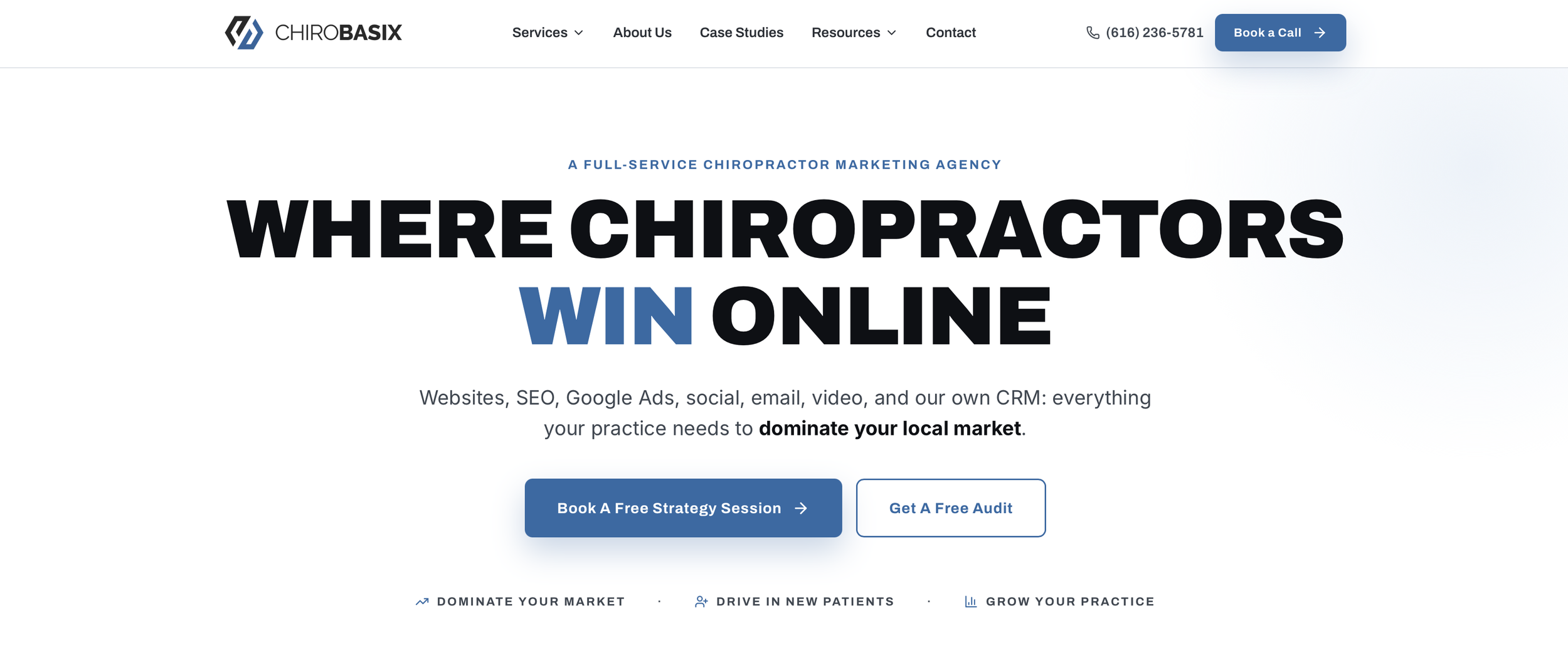
CHIROBASIX offers websites, local SEO and answer engine optimization, paid advertising, reputation management, and email and text marketing.
Its website-only program costs $150 per month, while its full marketing program is listed at $2,300 per month, excluding advertising spend. Other programs are priced by channel. The agency advertises no setup fee.
Marketing programs include its ENGAGE CRM and Virtual CA assistant; the website-only program does not. Marketing terms can be monthly or annual, while websites carry a one-year term.
This makes follow-up functionality an important part of the comparison. Ask to see how an inquiry becomes a confirmed appointment and how your team corrects or takes over automated conversations.
Before signing: Confirm usage limits, integration responsibilities, website transfer after the initial term and the reporting available for attended appointments.
7. ROCKET CHIRO
Worth considering for: Solo and smaller practices wanting direct support and separately priced services.

Rocket Chiro’s services page lists website services from $150 per month and Google Ads management from $250 per month, with a $500 minimum advertising budget. Ads management is available to its website clients.
The agency emphasizes direct work with a former practicing chiropractor and advertises no long-term contracts for its website service.
Check the total carefully. Its services page lists website plus local SEO/GEO from $1,000 per month, while its website information page lists that bundle from $1,500 and describes a $400 initial setup fee for the standard website service. Request a written current quote to resolve those differences.
Before signing: Confirm the setup charge, ongoing SEO deliverables, support arrangements and whether the proposed website is a subscription or a separately owned build.
8. HARRIS & WARD
Worth considering for: Practices combining local search with original photography and video.

Harris & Ward’s chiropractic services include website design, SEO, paid advertising, photography and video.
That combination is worth considering when your website needs to communicate the experience of visiting your practice. Original images of the clinicians, reception and consultation spaces can help answer practical questions that generic imagery leaves unresolved.
The agency’s published overview describes programs starting at $850 per month and month-to-month terms. The final scope depends on the market and goals; do not assume every listed service is included at the entry price.
Before signing: Ask whether on-site production, travel, website development and advertising management are included, and request examples of reporting beyond calls and form submissions.
9. CARDINAL DIGITAL MARKETING
Worth considering for: Multi-location groups coordinating patient acquisition across markets.

Cardinal Digital Marketing has a dedicated chiropractic offering and positions its broader business around healthcare performance marketing for multi-location provider groups.
Its search marketing and website capabilities make it worth considering when several clinics need coordinated acquisition, location-specific pages and a consistent view of performance.
For a group practice, the proposal should reflect differences between locations. A clinic with open appointment capacity needs a different budget and campaign priority from a clinic whose clinicians are already fully booked.
Request a tailored proposal rather than assuming a standard single-practice package. Cardinal’s homepage also identifies it as Power Digital’s healthcare division.
Before signing: Establish location-level fees, reporting access, integration scope and how budgets will move when capacity or demand changes.
10. THRIVE INTERNET MARKETING AGENCY
Worth considering for: Practices seeking a broad mix of digital marketing services.

Thrive offers chiropractic digital marketing, with dedicated services covering search optimization, paid advertising, social media, website work and reputation management.
Its breadth may suit a practice that wants several disciplines managed through one relationship. Request a proposal tied to your current website, target locations and appointment goals.
When reviewing evidence, ask what the agency measured. A rise in search visibility, an increase in inquiries and growth in attended new patient visits are different outcomes.
Pricing requires a proposal for the relevant scope. Clarify the assigned team, your account representative and the work each service fee covers.
Before signing: Request a recent chiropractic example with dates and budget context, plus a clear explanation of how your team and the agency will share responsibility for conversion improvements.
BUILD A CHIROPRACTIC MARKETING STRATEGY AROUND YOUR PRACTICE GOALS
A strong marketing strategy connects visibility, patient confidence and appointment availability. Before buying more online advertising, identify where your chiropractic marketing efforts currently lose momentum: discovery, inquiry, booking or attendance.
For clinic owners, a strong online presence should help potential patients understand the practice and take a useful next step. More website visitors are valuable only when the additional attention supports relevant inquiries and practice growth. In a crowded digital world, clarity about your clinicians, location and first-visit process gives people a practical reason to contact you.
LOCAL SEO AND GOOGLE BUSINESS PROFILE MANAGEMENT
Chiropractic SEO should address both your website and your visibility in local search results. Ask what the agency includes in Google Business Profile management, such as checking business details, maintaining appropriate categories, updating hours and managing relevant photos and service information.
Google Business Profile work should be coordinated with accurate location pages and consistent listings. Review your local competition and the distance patients realistically travel. High-intent searches such as “chiropractor near me” can attract qualified leads, but rankings alone do not establish whether those people book or attend.
Ask how the team uses Google Search Console to examine queries, indexing and website clicks from Google search results. Technical SEO should address issues that prevent a search engine from accessing or understanding important pages. Profile performance and website search performance should be reported separately where the data allows.
A CHIROPRACTIC WEBSITE THAT HELPS PATIENTS BOOK
Before commissioning a new website, ask whether your existing website can support your goals with better navigation, content, speed and booking options. A redesign should solve a defined problem.
Agencies advertising high converting websites should explain the conversion being measured. A submitted appointment request is different from a confirmed visit. Show your location, clinicians, hours, payment information and what someone can expect when seeking chiropractic care. Make it easy to contact the practice online from a phone.
PAID ADS AND TARGETED MARKETING CAMPAIGNS
Paid ads can complement organic visibility when a practice has appointment capacity and a clear offer. Separate Google Search campaigns aimed at active demand from social media campaigns introducing the clinic to a wider local audience.
Google Ads can begin generating inquiries within days of an approved campaign going live, but this is a possibility rather than a promised timeline. Search demand, budget, targeting and the booking experience determine whether those early inquiries become patients. Give targeted ads dedicated landing pages and reliable performance tracking before increasing spending.
Social retargeting is sometimes proposed to reconnect with website visitors who did not book. Healthcare practices should not assume that ordinary retail remarketing methods are suitable. Google restricts personalized advertising based on health information. Ask the agency to check each platform’s current rules and the data involved before proposing audience tracking.
REPUTATION MANAGEMENT AND PATIENT REVIEWS
Your online reputation gives prospective patients another way to evaluate the practice. A reputation management program should make it straightforward to request honest patient reviews, monitor online reviews and identify recurring service concerns. An optimization plan can improve the review-request process; it cannot guarantee a higher review score.
There are useful examples without relying on unsupported industry percentages. In its Mt. Lookout Chiropractic & Sports Injury Center case study, Demandforce reports nearly 2,000 reviews and an average rating of 4.85 after implementing automated review requests. These are historical results from one practice, not a typical outcome or a count of newly acquired patients.
SOCIAL MEDIA MARKETING AND PATIENT RELATIONSHIPS
Use social media marketing to introduce the team, answer practical questions and maintain a recognizable presence within your patient community. Video can help build trust by showing the people and environment behind the practice. Favor clear explanations and authentic practice footage over unsupported treatment promises.
Appointment reminders and appropriate email and SMS communication can support patient relationships and continuity of care. Ask whether these tools connect with your practice software, how preferences are respected and who handles replies. Their contribution to retention should be measured rather than assumed.
Demandforce advertises 100% more booked appointments, noting that its figures are based on 12 months of data and that results vary. That vendor claim is not a chiropractic-wide benchmark or evidence that a particular agency will double your bookings.
Local business relationships can also complement digital campaigns. Consider educational collaborations with relevant wellness providers and community organizations that help people understand your practice. Evaluate referral suitability and professional requirements before agreeing to any arrangement.
WHICH CHIROPRACTIC MARKETING AGENCY FITS YOUR PRACTICE?
Start with the constraint you need to remove. More advertising will not automatically solve unanswered calls, limited appointment availability or confusing information about the first visit.
| Your situation | What to prioritize | What to request |
|---|---|---|
| You are opening a new practice | A working website, accurate local information and a focused launch campaign | Launch milestones and a first-90-day budget |
| You want to fill an associate’s schedule | Relevant local demand and appointment availability | Reporting by clinician or appointment type where feasible |
| Your website attracts visitors but few inquiries | Clear service information and an easier booking journey | A conversion review covering mobile pages, forms and calls |
| Inquiries arrive but few patients attend | Response speed, clear expectations and reminders | Separate booking, cancellation and attendance reporting |
| You want to grow a specific service | Accurate service pages and matching targeting | Separate results for that service and clinician-approved copy |
| You are opening a second location | Location-specific visibility, content and capacity planning | Separate budgets and reporting for each clinic |
| You want fewer discount-driven inquiries | Clear positioning, pricing context and relevant targeting | Results segmented by offer and acquisition source |
| Your clinic is already close to capacity | Better appointment distribution and operational planning | A growth plan linked to real capacity |
Tell prospective agencies which appointments you want to grow, where patients typically travel from and what your team can accommodate. A broad goal of “more leads” leaves too much undefined.
HOW MUCH DO CHIROPRACTIC MARKETING SERVICES COST?
The prices in this comparison cover different purchases. A $150 website subscription, a $2,300 marketing program and a $3,500 service fee should not be averaged into a supposed industry rate.
Have each shortlisted agency complete the same budget breakdown.
| Cost category | What to establish |
|---|---|
| Agency management | Included channels, monthly deliverables and account support |
| Website | Setup, hosting, maintenance, content and ownership terms |
| Advertising | Amount paid to each platform, separate from management |
| Software | CRM, booking, call tracking and messaging charges |
| Photography and video | Production, travel, editing and usage rights |
| Additional locations | Extra fees for local pages, profiles and campaigns |
| Exit costs | Notice requirements, outstanding balances and migration work |
For illustration, a practice paying $3,500 in agency fees, $2,500 in advertising and $200 for additional software would spend $6,200 per month. This is a hypothetical budget, not a recommended minimum or a complete NearLead quote.
Request the first-month total and the full first-year commitment. Separate one-time development costs from recurring management and media spend.
MEASURE HOW MARKETING CAMPAIGNS BRING IN NEW PATIENTS
Lead reporting is useful, but the outcome sits further along the patient journey. Agree on definitions for:
Inquiries: New calls, messages and form submissions.
Qualified inquiries: People seeking services your practice provides who can realistically attend.
Bookings: Confirmed appointments, rather than unconfirmed requests.
Attended first visits: New patients who arrive for their initial appointment.
Collected revenue: Payments received over a defined reporting period, where appropriate reporting is available.
This hypothetical example shows why the cheapest lead is not always the stronger acquisition result. Both campaigns use the same definition of a new patient, and spending includes advertising and allocated management fees.
| Measure | Campaign A | Campaign B |
|---|---|---|
| Total acquisition spend | $6,000 | $6,000 |
| Inquiries | 120 | 80 |
| Cost per inquiry | $50 | $75 |
| Booked first appointments | 40 | 40 |
| Attended first visits | 24 | 32 |
| Attendance rate among booked appointments | 60% | 80% |
| Cost per attended first visit | $250 | $187.50 |
Campaign A appears cheaper at the inquiry stage. Campaign B produces more attended first visits for the same acquisition spend.
These figures do not establish profitability. Consider collections, discounts, clinician time, staffing and the cost of delivering care. Further appointments should follow clinical need and patient choice, rather than a marketing target for visit volume.
Separate existing-patient scheduling, duplicate contacts, irrelevant calls and new patient inquiries. Otherwise, ordinary administrative activity can inflate acquisition results.
ACCOUNT FOR LOCATION, CAPACITY AND APPOINTMENT AVAILABILITY
An inquiry from someone who cannot reach your clinic or attend during available hours is different from an inquiry that fits your schedule. Review geographic targeting alongside appointment availability and front-desk response times.
Compare equivalent periods where possible. Changes in opening hours, clinician availability, offers and advertising budgets can affect results even when the marketing approach stays the same.
QUESTIONS TO ASK BEFORE SIGNING
WHAT WOULD YOU PRIORITIZE DURING OUR FIRST 90 DAYS?
Request a sequence tied to your starting point: measurement, website improvements, local search, advertising and booking improvements. Identify tasks that depend on your team providing photographs, service details or approvals.
CAN YOU SHOW HOW YOUR REPORTED RESULTS WERE MEASURED?
Ask for reporting dates, spending and clear definitions. Determine whether a result describes clicks, leads, confirmed bookings, attended visits or collected revenue. Request evidence that is relevant to your market and goals.
HOW WILL YOU CONNECT MARKETING WITH APPOINTMENT ATTENDANCE?
Agree on the handoff between the website, front desk and booking system. Ask who marks appointments as attended or canceled and how reporting avoids counting one person several times.
WHO OWNS OUR WEBSITE AND ACCOUNTS?
Cover the domain, website, advertising accounts, analytics, creative files and tracking numbers. Clarify which assets transfer and whether leaving would require rebuilding the site.
WILL YOU WORK WITH OTHER CHIROPRACTORS IN OUR AREA?
If exclusivity is offered, define the geography and exceptions in writing. If it is not offered, ask how the agency manages competing accounts and protects confidential campaign information.
WHO APPROVES CLINICAL CONTENT AND PATIENT COMMUNICATION?
Establish a review process for service descriptions, advertising claims, offers and automated messages. Ask the agency to map what information its forms and tools collect, where it goes and who can access it. Have the practice’s responsible advisers review the proposed setup before launch.
WHAT HAPPENS IF WE CANCEL OR REDUCE SERVICES?
Check notice deadlines, renewal periods, website balances, data exports and transition support. Website, software and marketing services may have different commitments.
HOW MUCH WEIGHT SHOULD YOU GIVE AI SEARCH?
AI search belongs in the discussion, but an agency should explain the actual work behind the label. For a chiropractic practice, that can include clear service information, accurate location details, practitioner credentials and helpful answers to first-visit questions.
Google’s guidance on AI features says established SEO practices remain relevant and that no additional technical requirements are necessary for appearing in AI Overviews or AI Mode. This guidance concerns Google’s systems, not every AI platform.
Structure digital content with descriptive headings, direct answers and clear attribution so readers and search systems can understand it. Do not rewrite clinical information merely to match an AI-generated recommendation. Ask which questions and locations the agency will monitor and how it will repeat those checks. A single screenshot of an AI recommendation does not demonstrate consistent visibility or appointment growth.
Judge the work alongside website visits, qualified inquiries and attended first visits where measurement allows. AI visibility should support a broader acquisition strategy.
FREQUENTLY ASKED QUESTIONS
IS A CHIROPRACTIC SPECIALIST BETTER THAN A GENERAL MARKETING AGENCY?
A specialist may understand practice operations and patient communication more quickly. A broader agency with strong local market experience may offer useful capabilities across websites, SEO and advertising. Evaluate the people handling your account, the proposed work and the evidence behind their recommendations.
SHOULD A NEW CHIROPRACTIC PRACTICE HIRE A FULL-SERVICE AGENCY?
That depends on available budget and appointment capacity. A new practice may first need a professional website, accurate local profiles, reliable inquiry handling and one focused acquisition channel. Ask how the proposed services support your launch and what can be added later as demand grows.
WHICH CHIROPRACTIC MARKETING CHANNELS SHOULD WE PRIORITIZE?
Start with the way prospective patients find and evaluate your clinic. Local SEO and search advertising can address active searches, while a clear website helps people assess your practice. Social content and advertising can introduce your clinicians and explain the first-visit experience. Choose the mix around your location, goals, budget and ability to respond.
ARE ADVERTISING COSTS INCLUDED IN AGENCY FEES?
Do not assume they are. Agency management, advertising spend, software and website costs may be separate. NearLead’s $3,500 monthly service fee excludes advertising spend. Request an itemized budget showing what reaches each platform and what pays for management and technology.
WHAT IS A GOOD COST PER CHIROPRACTIC LEAD?
There is no single target that suits every practice. A low-cost inquiry has limited value if the person never books or attends. Evaluate cost per qualified inquiry alongside booking rate, attendance and cost per attended first visit. Set an affordable acquisition target using your practice’s actual collections and delivery costs.
CAN AN AGENCY HELP REDUCE NO-SHOWS?
It may help improve appointment communication, reminders and the clarity of the offer, depending on scope. Your front desk and scheduling process also matter. Ask how the agency identifies where bookings are lost and who implements changes. Measure attendance separately from lead volume.
WHAT SHOULD A CHIROPRACTOR MARKETING AGENCY REPORT EACH MONTH?
Expect spending, completed work, qualified inquiries, bookings and attended first visits where reliable tracking is available. Traffic and rankings provide context. Reporting should explain what changed, what remains uncertain and what the team will improve next.
DO WE NEED TO OFFER DISCOUNTED FIRST VISITS?
No. An introductory offer is one possible approach, not a requirement. Your website can also explain practitioner experience, appointment availability, the first-visit process and payment arrangements. If you use an offer, make its inclusions clear and evaluate attended appointments rather than judging it only by cheap leads.
HOW LONG DO LOCAL SEO AND PAID ADS TAKE TO PRODUCE RESULTS?
Evaluate delivery and measurement from the beginning. Google Ads may generate leads within days after launch, while chiropractic SEO generally needs a longer evaluation window. CHIROBASIX describes three to six months as its expected window for noticeable ranking improvements. Treat this as that provider’s estimate, not a universal deadline or a promise of new patients. Local competition, site history and implementation affect timing. Agree on milestones and review measurable results throughout the engagement.
CAN WE KEEP OUR CHIROPRACTIC WEBSITE WHEN WE CHANGE AGENCIES?
That depends on the contract and platform. Some arrangements allow a functioning site to transfer; others provide selected assets that require a rebuild. Confirm ownership, hosting options, transfer charges and any remaining commitment before signing.
SHOULD A MULTI-LOCATION PRACTICE USE ONE AGENCY?
One agency can simplify coordination, but each clinic still needs appropriate local execution. Request separate reporting for location budgets, qualified inquiries and attended visits. A strong result at one clinic should not hide weak performance at another.
CHOOSE A PARTNER AROUND THE PRACTICE YOU WANT TO BUILD
Before requesting proposals, identify the services you want to grow, your priority locations, available appointment capacity and total monthly budget. Decide whether success means filling a new clinician’s schedule, improving first-visit attendance or supporting another location.
Give the same brief to two or three agencies. If an agency offers a free consultation, use it to review your current position and the priorities behind its proposal. Compare work, fees, evidence and commitments, then ask how the team intends to consistently generate suitable inquiries. The goal is more patients your chiropractic business can serve well, with measurable results tied to appointment attendance.
Considering NearLead? Start a conversation about your website, search visibility and local patient acquisition goals. Services cost $3,500 per month, excluding advertising spend, with a free website and $0 initiation fee. The initial commitment is 12 months, followed by month-to-month service.
“You bring the business, we’ll bring the marketing. Together, we’d be unstoppable.”
