
Related Posts


A dental website should help a prospective patient answer a few practical questions: Do you provide the care I need? Who will treat me? Can I reach your office? And how do I arrange a visit?

The right website design agency should make those answers easy to find while presenting your practice accurately. Treatment pages, original photography, mobile navigation and appointment requests all contribute to the experience. What happens after someone submits a form matters as much as the appearance of the homepage.
Whether you are commissioning a new dental website or improving an existing dental site, the main focus should be helping the right patients understand your practice and arrange appropriate care. A beautiful dental website also needs useful content, reliable forms and a plan for measuring practice growth.
Choosing a provider becomes harder when one proposal covers a standalone website, another requires ongoing marketing and a third combines design with patient communication software. Similar feature lists can conceal different costs, ownership rights and commitments.
This guide compares ten dental website design agencies and providers serving US practices. We examine their services, available client work, published prices and the questions worth asking before signing.
Editorial note: Nearlead is the publisher-affiliated selection and appears first by editorial choice. This is a shortlist for different practice needs, rather than an independently scored performance ranking. Information was reviewed in October 2026 for this 2027 guide. Reconfirm pricing, scope and terms before purchasing.
Compare the Top Dental Website Design Agencies
Compare the complete purchase, including website development, recurring fees and required marketing services. A website subscription and a one-time build are different offers.
| Agency or provider | Worth considering for | Pricing | Important consideration |
|---|---|---|---|
| 1. Nearlead | A clearly priced website purchase with optional ongoing marketing | $3,500 one-time fee, or included at no additional cost with a marketing retainer | Confirm pages, content, hosting, ownership and the selected retainer's terms |
| 2. Wonderist Agency | A dental website built around original photography, video and practice identity | Custom proposal | Its websites use Webflow; confirm platform costs, editing and transfer options |
| 3. :Delmain | Dental websites paired with ongoing acquisition support | Website designs advertised from $6,500 | Website page specifies a six-month marketing retainer after launch, then month-to-month service |
| 4. Studio 8E8 | Storytelling, photography and video integrated into the website | Custom proposal | Compare its framework-based and fully custom website options |
| 5. Golden Proportions Marketing | WordPress websites with defined page packages and broader dental marketing | Custom proposal | Essentials lists 15 pages; Pro lists 20; confirm production and ongoing costs |
| 6. ProSites | Dental practices comparing pre-designed, semi-custom and custom website options | Request current setup and monthly pricing | Confirm subscription conditions, content customization and transfer rights |
| 7. PBHS / RevenueWell | Dental and specialty websites with related communication and intake tools | Custom proposal | Treat these as connected brands; verify the website and software scope |
| 8. Sesame Communications | Dental and orthodontic websites with content and booking options | Custom proposal | Booking is an optional add-on; confirm current software compatibility |
| 9. WEO Marketly | Dental websites ranging from starter projects to more extensive custom builds | Custom proposal | Confirm the differences between Quick-Start, Lux and Custom packages |
| 10. My Social Practice | Tiered website offers with published build and monthly fees | Published builds: $2,400, $3,200 or $12,000; monthly fees: $199 or $399, depending on tier | Content, media and integration allowances differ by package |
All prices are in USD. Nearlead's price was supplied by the publisher. Competitor figures come from the linked public sources below. A custom quote does not imply a higher price than Nearlead. Compare equivalent scopes and the full required commitment.
How We Selected These Dental Web Design Companies
We reviewed public service pages, website portfolios, package details and available client examples. The shortlist includes dental specialists and website providers alongside Nearlead's broader digital services offering.
Our assessment considered:
Dental relevance: Named practices, specialty examples and clearly described dental services.
Website scope: Design, development, copywriting, photography, video and revisions.
Patient experience: Mobile usability, treatment information, office details and appointment requests.
Integrations: How website inquiries connect with scheduling and practice systems.
Commercial clarity: Build prices, subscriptions, required retainers, maintenance and ownership.
Evidence: Whether published outcomes relate to a website project or a broader campaign.
The descriptions assess fit. They do not establish that one agency consistently outperforms another. Published results are agency-reported and have not been independently audited. Nearlead's local-business example illustrates its acquisition and conversion approach; it is not a dental practice case study.
When a marketing company describes experience in the dental industry, ask which dental clients the proposed web designers have supported and what they actually delivered. Familiarity with terminology is useful, but it should be accompanied by an understanding of appointment requests, clinical review and office follow-up.
1. Nearlead
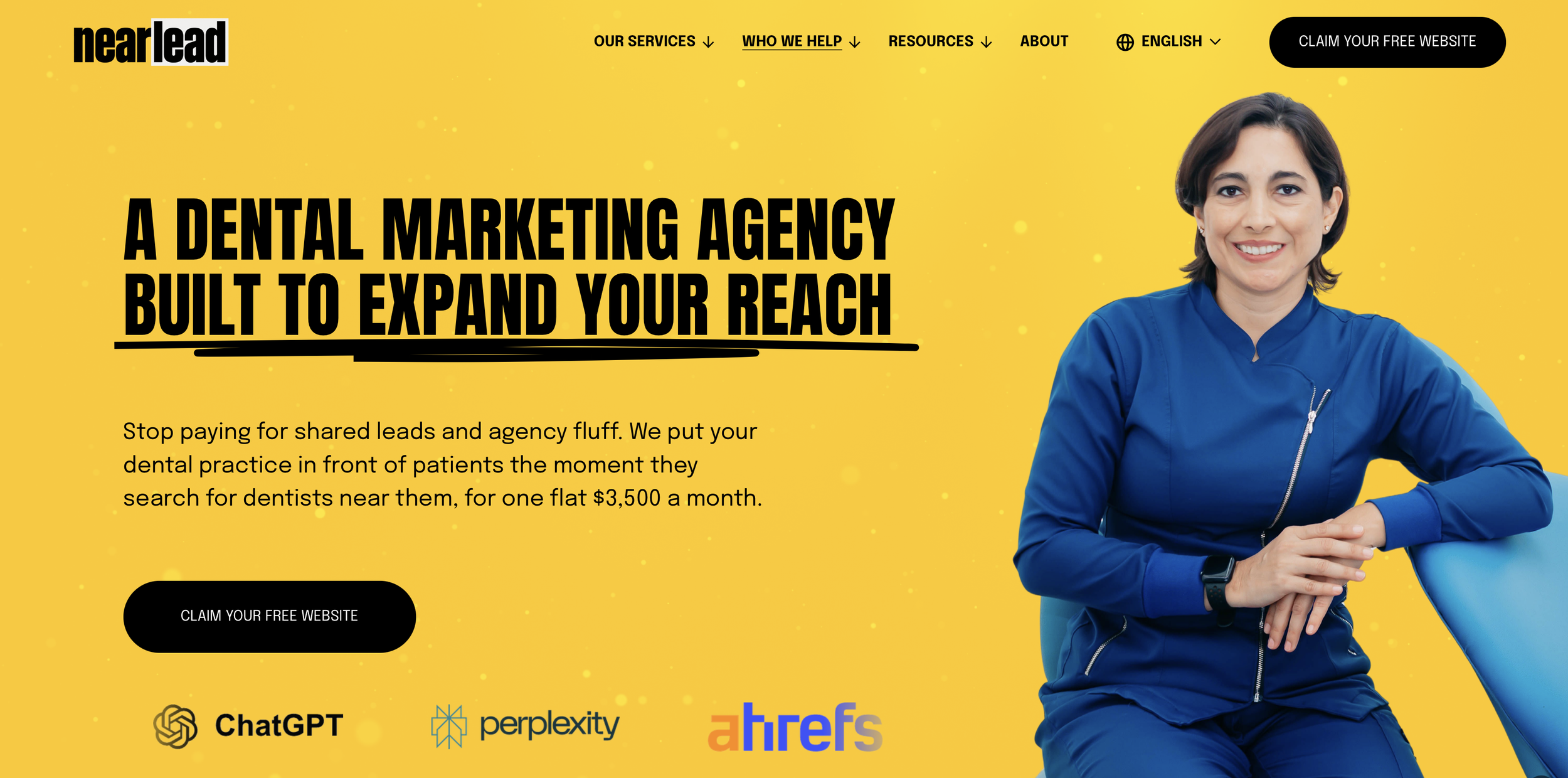
Worth considering for: Dental practices wanting a $3,500 one-time website purchase, with the option to add ongoing marketing.
Nearlead offers website development alongside SEO, local SEO, AI search, search advertising and content marketing. Practices can purchase the website as a defined project or have it included at no additional cost with a marketing retainer.
The brief should begin with your practice, patients and capacity. A general dental office welcoming families needs a different emphasis from a specialist attracting referrals or a practice promoting implant consultations. Those priorities should shape treatment pages, team information, patient resources and the appointment process.
Pricing and Value
Website pricing is $3,500 as a one-time fee, or included at no additional cost with a marketing retainer.
The standalone option gives practices a clear build price to evaluate against the proposed scope. For the retainer option, compare the full marketing fee, commitment and services. Confirm hosting, maintenance, revisions, software and ownership in writing for either route.
Available Client Evidence
For a local-business engagement, Nearlead reports:
64% growth in relevant traffic.
147% more leads.
Website conversion rate increased from 6% to more than 19%.
Cost per lead declining from $45 to $24.
The figures compare matching three-month periods year over year to account for seasonality. They are supplied, agency-reported results from a wider marketing engagement. They should not be read as dental-specific outcomes or as improvements attributable solely to website design.
Before signing: Confirm the page count, original copy, platform, revision allowance and ownership provisions. Specify how appointment requests reach the office, which integrations require extra fees and who reviews the handling of patient information.
2. Wonderist Agency

Worth considering for: Practices that want original photography, video and a distinctive practice identity built into their website.
Wonderist's dental website offering emphasizes real practice imagery, customized copy and patient contact routes. Its featured Flash Dental project in Houston uses photography and video to introduce the office experience.
The agency builds and hosts its websites through Webflow and describes an editor for routine content changes. That makes platform access, staff training and ongoing hosting useful points to compare during discovery.
Pricing requires a proposal. Ask how the quoted scope separates the website, media production and ongoing marketing.
Before signing: Request examples matching your practice type, confirm what photography and video production includes, and establish what you receive if you transfer the website to another provider.
Source: Dental websites, featured work and platform details.
3. :Delmain
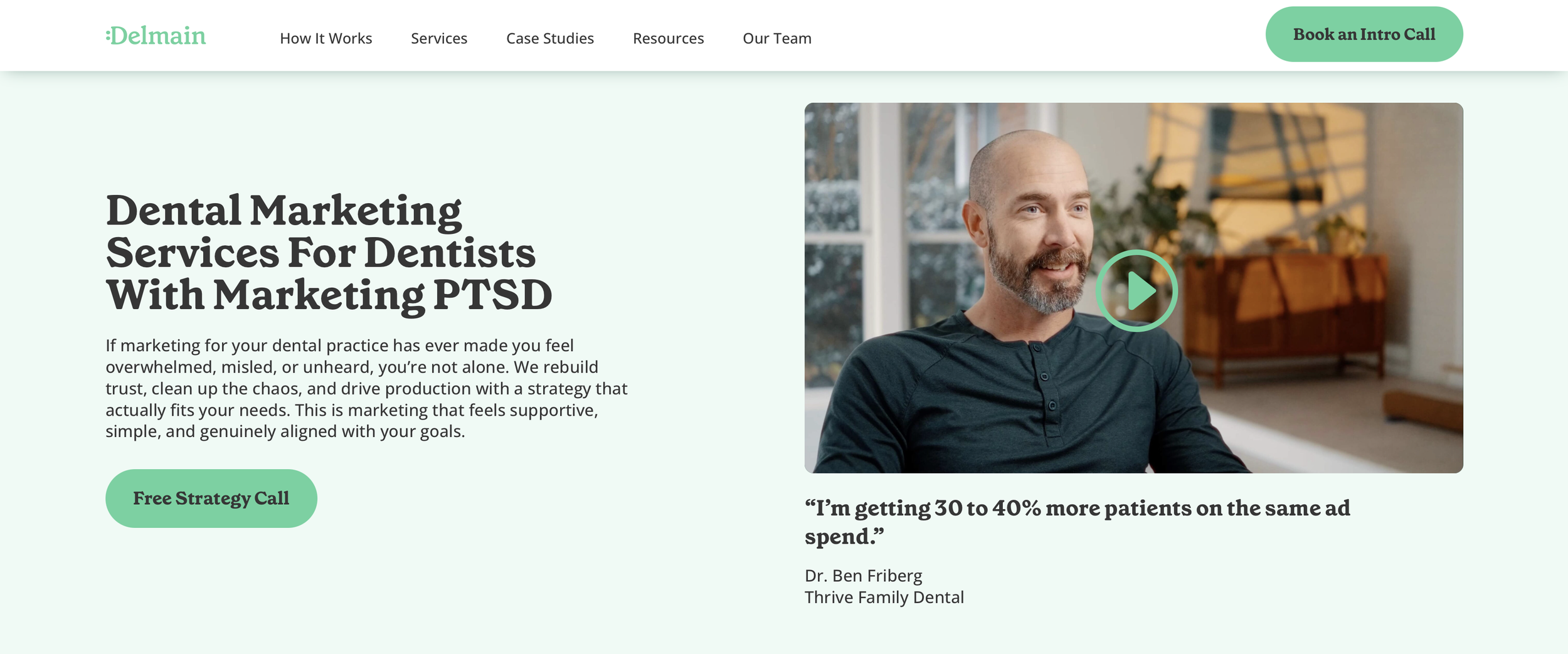
Worth considering for: Practices that want a dental website paired with ongoing acquisition support.
:Delmain offers websites for startups, acquisitions, established practices and dental groups. Its portfolio includes Enamyl Dentistry, Village Dental and Atlanta Center for Advanced Periodontics.
Website designs are advertised from $6,500. The website page states that a six-month digital marketing retainer follows launch, then service becomes month-to-month. Confirm the additional fee and full required commitment.
Its Timberhill Dental example reports growth from 12 new patients per month to more than 80. That is evidence from a broader marketing relationship, rather than an isolated return from design. The page also states that clients own their websites.
Before signing: Clarify the build scope, recurring services, software integrations and practical transfer process. Request a result with dates, budget and patient definitions that match your situation.
Source: Dental website designs, pricing, terms and client examples.
4. Studio 8E8
Worth considering for: Practices seeking a website built around their story, team and original media.
Studio 8E8 separates its website offering into StudioSites, StorySites and ShowcaseSites. The first two use personalized frameworks with writing and photography; StorySites add video. ShowcaseSites are described as fully custom projects with extended production and additional pages.
Its portfolio includes 450 Aesthetic Dental. Ask to review comparable projects and the creative work included in the package being proposed, rather than assuming every example represents the same scope.
Pricing requires a proposal.
Before signing: Define the photography and video session, travel costs, production schedule, content ownership and post-launch support. Confirm how much design flexibility is available within each option.
Sources: Website options and production process · Portfolio.
5. Golden Proportions Marketing
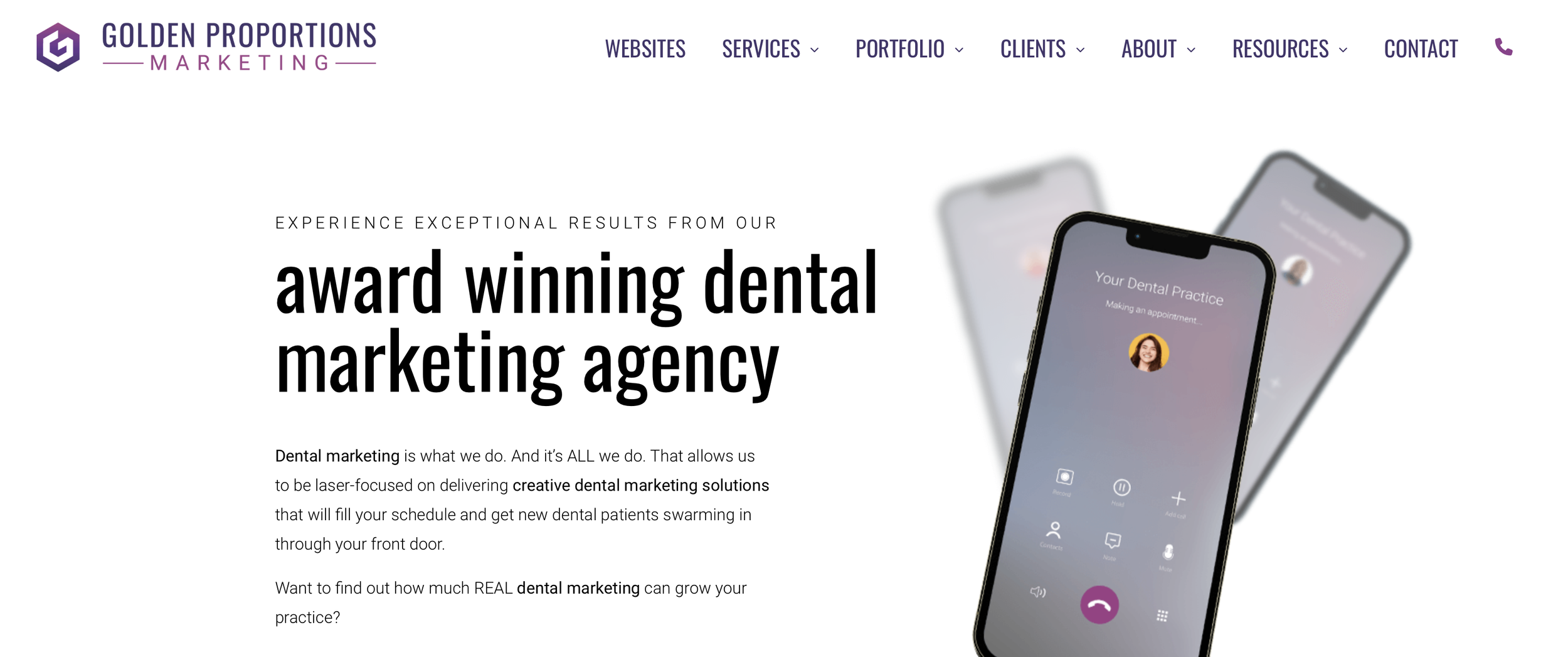
Worth considering for: Practices wanting a WordPress website with defined page packages and access to wider dental marketing services.
Golden Proportions lists an Essentials website with 15 pages and a Pro website with 20 pages. Both describe semi-custom design, custom content, WordPress, editing tools and client ownership. Fully custom projects are also available.
Its broader portfolio covers websites, logos, photography, video and other dental marketing materials. Ask which work is part of the website project and which requires a separate engagement.
Pricing requires a proposal; package names and page counts do not establish the final cost.
Before signing: Confirm how pages are allocated, what counts as custom content, revision allowances and the ongoing hosting and maintenance arrangement.
Sources: Website packages · Dental marketing portfolio.
6. ProSites
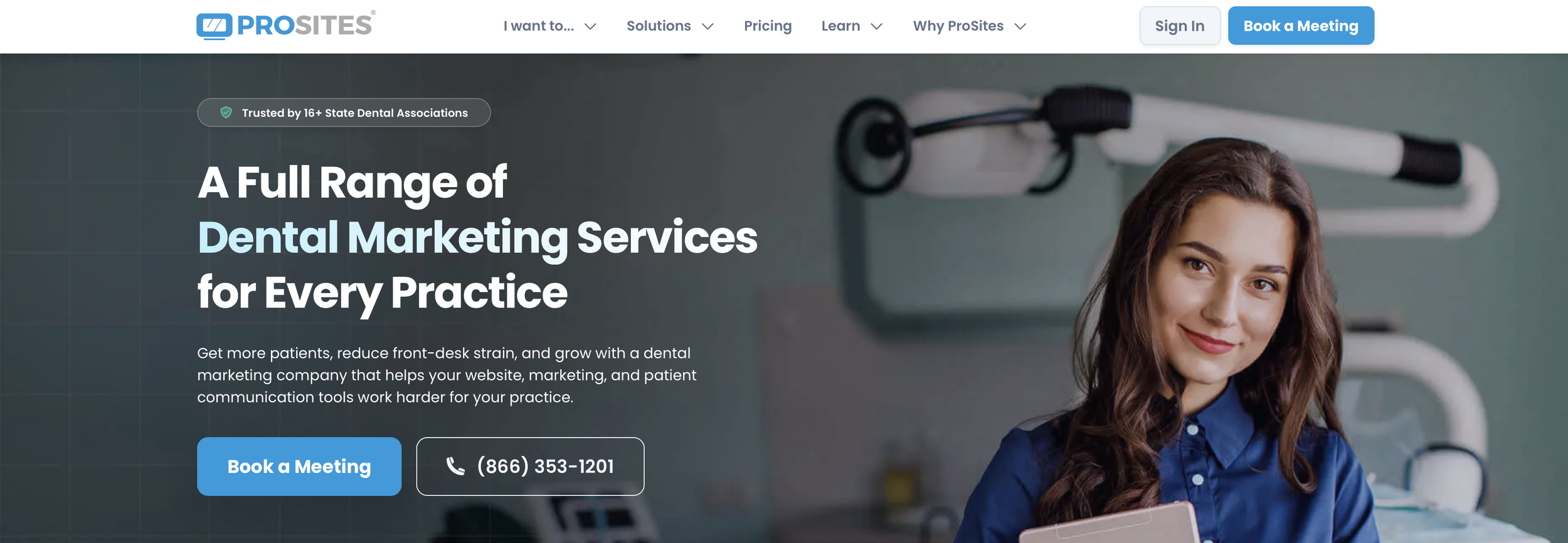
Worth considering for: Practices comparing a range of pre-designed, semi-custom and custom website options.
ProSites publishes four design levels: Basic, Semi-Custom, Custom and Custom Pro. Its package descriptions vary in layout customization, banners and design consultation. Listed features also include a website editor and customizable educational content.
This model is worth evaluating when you want a defined starting point and an ongoing support arrangement. Ask how much your team can change and what differentiates the resulting website from other practices using the same design framework.
Request current setup and recurring pricing.
Before signing: Establish the exact subscription terms, content rights, ownership and transfer options. Ask what is included in routine updates and what would trigger a separate charge.
Source: Dental website design levels and features.
7. PBHS / RevenueWell
Worth considering for: Dental and specialty practices exploring website design alongside communication and intake tools.
PBHS is a RevenueWell company, following its acquisition in 2021. Its services cover website design, branding, video and digital marketing, with portfolio categories for general dentistry and several dental specialties.
RevenueWell's current website offering ranges from standard templates to custom designs and describes an onboarding specialist, mobile layouts and dental content. PBHS also lists related products for registration, communication and website chat.
Treat these as connected offerings and request a clear explanation of which brand, team and software your agreement covers. Pricing requires a proposal.
Before signing: Confirm integration compatibility, optional products, support responsibilities and what transfers if the relationship ends.
Sources: PBHS background and services · RevenueWell website offering.
8. Sesame Communications
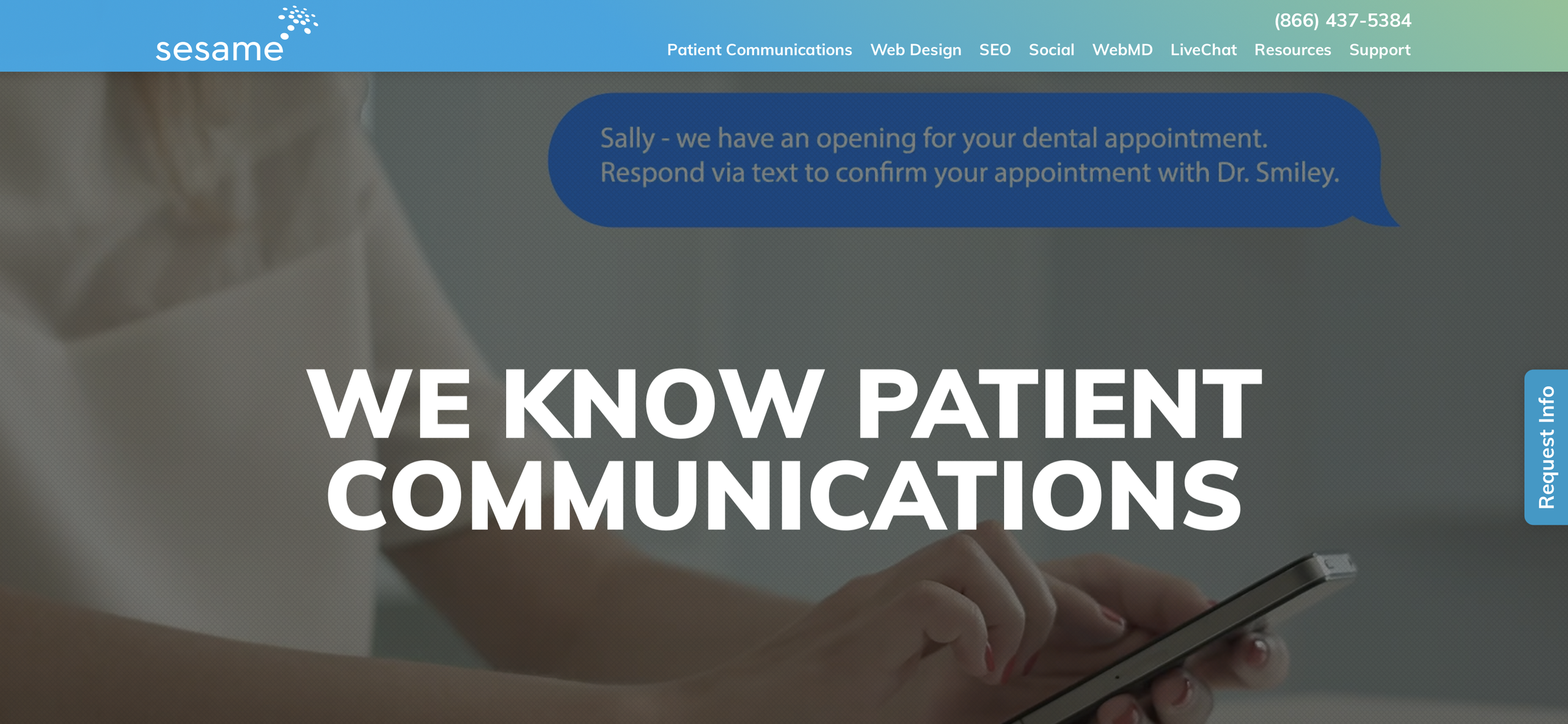
Worth considering for: Dental and orthodontic practices seeking website design with content, maintenance and optional booking features.
Sesame describes responsive websites, practice branding, content editing and hosting support. Its premium design gallery provides live template examples that can help practices assess available layouts and patient navigation.
Online appointment booking is listed as an optional add-on with specific practice-management integration requirements. Confirm the current compatibility of your software and version rather than assuming a booking tool connects automatically.
Pricing requires a proposal.
Before signing: Ask whether patients request a time or book a confirmed slot, what information passes between systems, and which features depend on an ongoing subscription.
Sources: Website services and booking options · Design gallery.
9. WEO Marketly
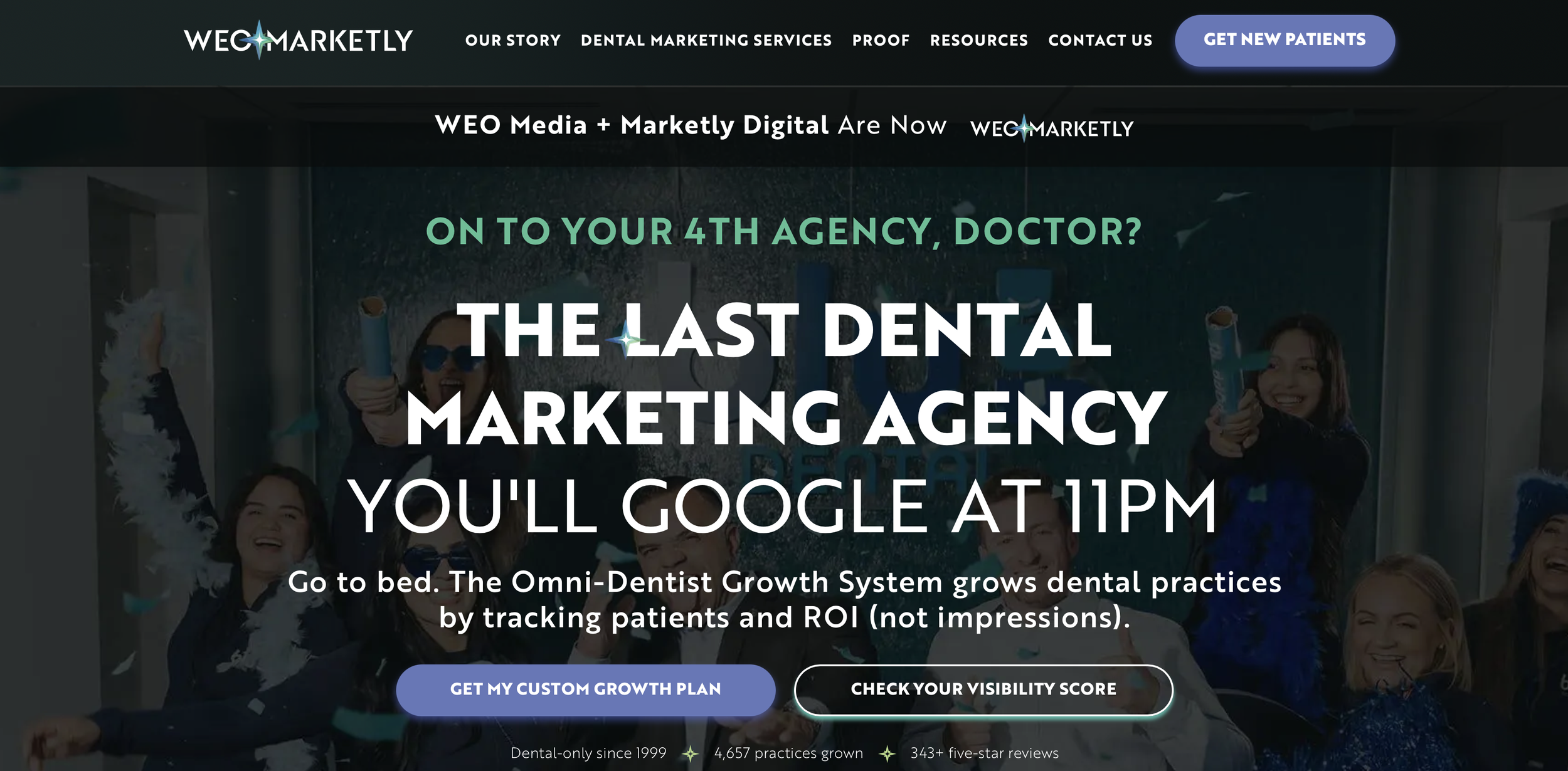
Worth considering for: Practices comparing a starter website with more extensive design and production options.
WEO Marketly lists Quick-Start, Lux and Custom website packages. The options differ in the scope of content, design and development, with its website service positioned alongside photography, video and booking tools.
Named portfolio examples include Hazen Smiles, Gallery B Smiles and Prime Orthodontics. Review the examples closest to your practice and establish which package produced them.
The Roadside Dental Marketing domain currently redirects to WEO Marketly, and its website materials identify Roadside as the former name in a client testimonial. Use the current brand when requesting details.
Pricing requires a proposal.
Before signing: Confirm page allowances, original media, design flexibility, delivery milestones and whether ongoing marketing is required.
Source: Current dental website packages, portfolio and client materials.
10. My Social Practice
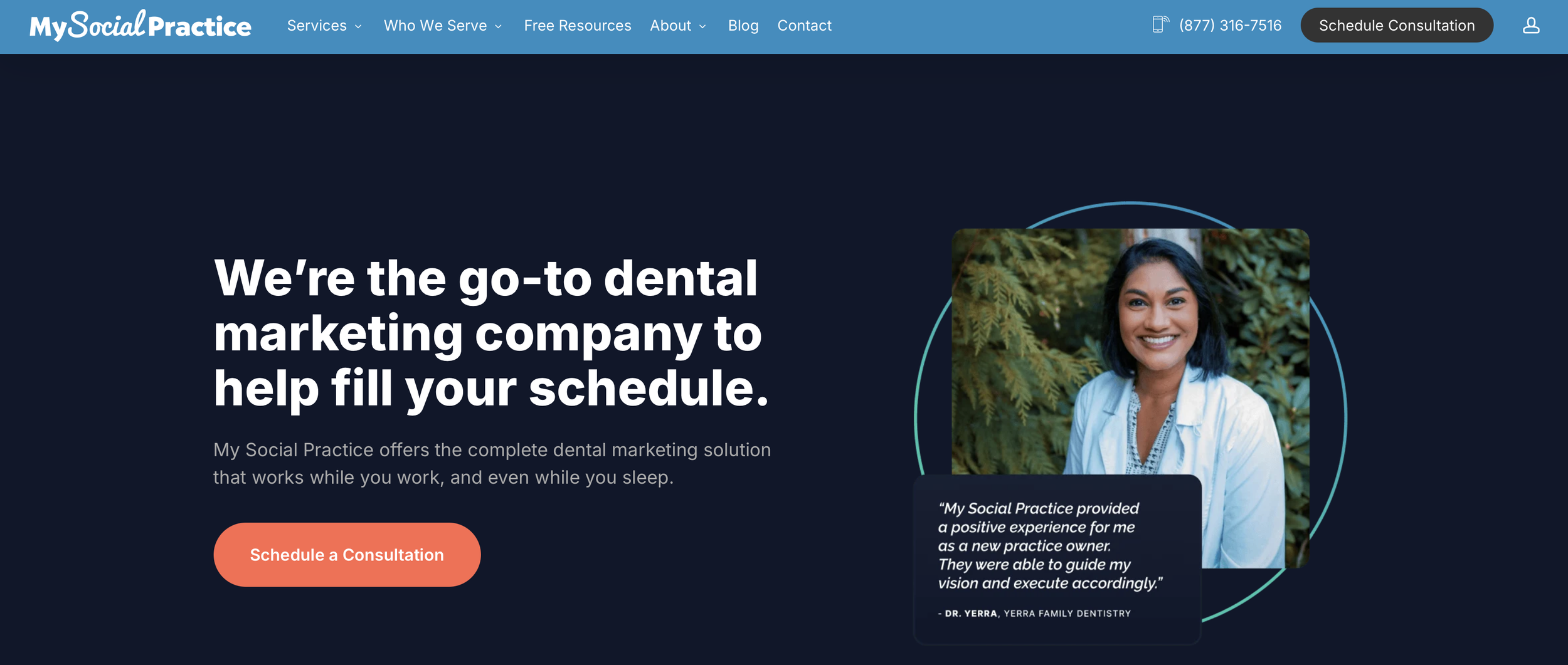
Worth considering for: Practices wanting published website tiers with different content and integration allowances.
My Social Practice lists build fees of $2,400, $3,200 and $12,000, paired with monthly fees of $199, $399 and $399, respectively.
Its Essential tier lists a basic appointment request without integrations. Performance adds scheduling and practice-management connections, while Signature includes a media production package. The tiers also differ in content treatment, so compare those details rather than the build price alone.
Before signing: Confirm your software's compatibility, the content included, monthly support, minimum term and website ownership. Request the complete first-year cost for the selected package.
Source: Published website tiers, pricing and inclusions.
Which Dental Website Design Agency Fits Your Practice?
Start with the patients and services you want the website to support. A larger package will have limited value if its emphasis does not match your practice or available appointment capacity.
| Your situation | What to prioritize | What to request |
|---|---|---|
| You are opening a practice | Accurate pre-opening information and a clear inquiry process | Launch milestones, required content and an opening-date plan |
| You have acquired a practice | Clear ownership information and continuity for current patients | A plan for branding, URLs, staff details and patient communication |
| You want more general dentistry patients | Location, new-patient information and suitable booking routes | A mobile walkthrough from service research to an appointment request |
| You want more implant or cosmetic consultations | Relevant clinician expertise and informative treatment content | Suitable examples, content review and consultation-specific reporting |
| You are a specialist practice | Referral information and accurate specialty content | A referral workflow and examples from comparable specialties |
| Your office gets inquiries that rarely book | Response times, scheduling and qualification | A review of the full journey from website contact to attended visit |
| You operate multiple locations | Correct locations, teams, availability and inquiry routing | Location-level structure, access permissions and reporting |
What Should a Dental Practice Website Include?
A useful proposal translates practice priorities into pages, content and working patient journeys. Ask the agency to show how it will handle these requirements.
Accurate Treatment and Service Pages
Explain the services provided in language patients can understand. Use dedicated pages where a treatment needs its own explanation, clinician information and consultation route. Clear headings should guide visitors from a question about care to the relevant team and next step.
Have an appropriately qualified member of your team review clinical content before publication and when it changes. Keep explanations balanced and avoid unsupported promises about outcomes, suitability or recovery. The website should help people prepare for a conversation with your practice.
If you feature an intraoral scanner or other equipment, explain its actual role in the dental visit rather than relying on a technical name or an unsupported claim of better results. Descriptions of personalized service and patient comfort should reflect what your team provides. Treat language such as “pain free care” as a claim requiring careful clinical review, not a promise to add automatically.
Family Dentistry and Pediatric Practice Information
For family dentistry, explain who the practice sees, how families arrange visits and which services are available. A pediatric practice may need additional information for parents about preparing for a first visit and contacting the office with questions. Give potential patients useful information about the experience rather than filling pages with generic reassurance.
A Clear Introduction to Your Dentists and Team
Use accurate team bios, credentials and original photographs to introduce the people patients will meet. Explain your approach to care and show the office where useful. Specific evidence of experience and high quality work is more informative than unsupported superlatives.
The About page and treatment pages should work together. If a particular clinician provides a service, make that relationship clear rather than expecting visitors to connect separate pieces of information themselves.
Mobile Friendly Design and Accessible Navigation
Test phone links, menus and forms on actual mobile devices. Visitors should be able to check location, hours and services without struggling with cramped text or obstructive pop-ups.
The American Dental Association's website procurement guidance recommends professional, easy-to-navigate, responsive websites and describes designing for mobile before adapting to larger screens. A mobile first layout should keep key information, contact details and booking actions accessible across devices.
Ask about keyboard navigation, form labels, contrast, captions and other accessibility considerations during design and testing. A feature described as an accessibility tool should be assessed as part of the complete user experience.
Consistent Branding, a Clean Layout and Fast Loading
Keep the logo, typography, colors and tone consistent across every page. Whether you choose a minimalist design, a calming palette or more expressive abstract shapes, the design should support readable content and a user-friendly experience. Distinctive brand elements can help present the practice's identity; they do not establish patient trust or engagement on their own.
Use engaging visuals to show an inviting atmosphere while keeping navigation and actions clear. Real team and office photographs can communicate details that stock images cannot. If stock imagery is used, avoid presenting it as your own patients, premises or treatment results.
A clean layout should make important choices easy to understand. Evaluate whether those choices help convert visitors into suitable inquiries, rather than judging the design by appearance alone.
Ask how the site built for your practice will be tested for loading performance and responsiveness. Google's Core Web Vitals guidance covers loading, interaction and visual stability. Optimize images, video and third-party tools, then measure whether the changes help visitors find information and complete requests. Fast load times support usability, but do not guarantee appointment growth.
Clear Calls to Action That Help Convert Visitors
Distinguish a request for contact from a confirmed appointment. Explain which patient types or visit types can use an online booking tool and what happens after submission.
Use clear calls to action that match the page, such as requesting a consultation, booking a new-patient visit or calling the office. On the home page, help visitors find the main services and contact routes quickly. Test wording and placement against suitable inquiries and attended appointments; a general claim that buttons increase conversions should not substitute for results from your own site.
Confirm whether new and existing patients follow different routes, how appointment availability is supplied and who resolves failed submissions. A demonstration using your real scheduling workflow is more useful than a feature label.
New-Patient, Insurance and Payment Information
Make essential information easy to find: whether the office accepts new patients, how to request a visit, what to bring and whom to contact with questions.
Present insurance participation, payment arrangements and membership offers accurately. Identify who checks this information and updates it when policies change. Avoid wording that could imply a benefit or payment outcome the practice has not confirmed.
Genuine Reviews, Photography and Patient Stories
Use authentic reviews and patient stories with the appropriate permissions and approvals. Give readers context about the source and distinguish practice experience from a promised treatment result.
Patient reviews and patient testimonials can provide social proof about the office experience. Where appropriate, connect them with information about the team or service discussed. Building trust depends on accuracy and context, not simply adding more quotations or star icons.
For before and after photos, agree on consent, presentation and clinical review before publishing. Original team and office photography can help introduce the practice without relying on patient images. The site reinforces the practice's identity when its imagery, wording and real patient experience align.
Clear Location and Emergency Contact Information
Show the correct address, contact number, hours and useful arrival details. Multi-location websites should help visitors select the right office and reach the appropriate team.
If emergency appointments are offered, describe actual availability and contact arrangements. Your practice should approve any instructions shown when the office is closed.
Appropriate Forms, Tracking and Data Handling
Document what each form, chat tool, scheduler and analytics service collects, where the information goes and who can access it. Route medical histories and other sensitive intake through the practice's approved processes.
HHS guidance on online tracking explains that HIPAA obligations apply when regulated entities collect or disclose protected health information through tracking technologies. Its guidance also notes a court ruling that vacated part of its treatment of certain unauthenticated public-page visits.
Have your practice's compliance adviser review the actual configuration and any business associate agreements needed for the work. A generic claim that a website is “HIPAA compliant” should be supported by details about the systems and responsibilities involved.
Make HTTPS encryption a requirement for forms and pages transmitting patient information. Encryption in transit is one safeguard; it does not by itself establish HIPAA compliance. Confirm storage, access controls, vendor arrangements and the handling of submitted information as part of the review.
Search Engine Optimization and Migration Planning
If you already have a website, identify important pages, URLs, search traffic and existing appointment routes before rebuilding. Request a redirect map and post-launch testing plan.
Search engine optimization helps search engines discover and understand relevant practice pages. Accurate treatment information, useful local content and sound technical foundations can support visibility for appropriate searches. A clear service and location structure tells Google what the practice offers and where it operates, without guaranteeing a ranking.
Ask how the agency will connect this work with your Google Business Profile and measure relevant inquiries. A website can also support referrals and existing patients, so evaluate its full role rather than calling it useless if organic traffic is limited. Search visibility and patient engagement should be assessed alongside the site's other purposes.
Agree on launch checks for indexing, analytics, forms, business information and mobile use. The new design should support accurate content and useful navigation while preserving access to important practice information.
What Can You Learn From the Best Dental Websites?
Great dental websites help people understand the practice, assess its suitability and take a clear next step. Use the examples below as references for a design brief, rather than as proof that a particular visual style generates more business. They are practice websites, not additional entries in the agency ranking, and no agency relationship is implied unless stated.
Grand Street Dental: Services, Team and Patient Evidence
Grand Street Dental connects its cosmetic, family and restorative services with team information, press coverage and a before-and-after gallery. Its contact information and office hours are also available on the site.
It is a great example to discuss when deciding how a website should connect practice identity with evidence and practical information. Ask your agency to explain how its proposed structure will make those elements easy to find for your patients.
Zen Dental Studio: Patient Comfort Across Two Locations
Zen Dental Studio presents its San Francisco and Mountain View offices as two locations under one brand. The site describes the patient experience, introduces services and provides separate contact and booking routes for each studio.
The useful lesson is to keep the practice's message consistent while making local details specific. Describe how your team supports patient comfort and explain what visitors should expect before asking them to book.
Great Dental Websites Make Reviews and Costs Easy to Assess
Vivid Specialized Dentistry's new-patient page displays a claim of more than 200 five-star reviews alongside patient accounts. This Canadian practice is included as a design reference, rather than a US provider recommendation. Treat its review count as the practice's published statement and reconfirm it before quoting elsewhere.
The Gleamery publishes priced service packages and booking links. Its FAQ also explains that pricing is available online and in appointment confirmations. The design principle is to make relevant cost information understandable while keeping conditions and the services included clear.
Madison Park Family Dentistry and Village Dental: Read Metrics Carefully
In its dental website examples article, :Delmain reports that Madison Park Family Dentistry visitors spend an average of 4.4 minutes on the site. It also reports that 12% of new visits to Village Dental result in a booked appointment or another meaningful action.
These are agency-reported figures without a full measurement period or conversion breakdown in the summaries reviewed. The Village Dental figure should not be described as a 12% appointment-booking rate. Ask what each metric measures and how it relates to patients actually seen.
How Much Does Dental Website Design Cost?
The published offers in this guide cover different products. A one-time build, a subscription website and a design project followed by a marketing retainer should not be averaged into an industry rate.
Nearlead offers a $3,500 one-time website, or a website included at no additional cost with a marketing retainer. Some competitors publish lower initial build prices with recurring charges; others require a custom proposal. The useful comparison is the complete scope and commitment.
Ask each shortlisted provider for the same breakdown:
| Cost category | What to establish |
|---|---|
| Design and development | Pages, design approach, revisions and launch |
| Content and clinical review | Original writing, treatment pages, approvals and future updates |
| Photography and video | Production, travel, editing, usage rights and delivery |
| Hosting and maintenance | Updates, backups, security, support and included edits |
| Scheduling and integrations | Compatibility, implementation, subscriptions and ongoing support |
| Marketing | SEO, advertising management, content and reporting |
| Advertising spend | Media budget paid to platforms separately from management |
| Transfer and exit | Notice, remaining payments, exports and migration support |
For illustration, a $3,500 build plus a hypothetical $200 monthly allowance for hosting and support totals $5,900 over the first year. The allowance is an example, not a Nearlead hosting or support quote.
Request both the first-year total and the cost of continuing after the initial term. Establish whether ownership or transfer rights depend on completing payments or retaining other services.
Measure Appointment Outcomes, Not Just Website Inquiries
Before launch, agree on a baseline and a practical reporting process. A phone click, submitted form, booked consultation and attended appointment are different events.
Unbounce's 2024 benchmark reports a 4.3% median conversion rate for dental-services landing pages, with half between 2% and 8.3%. Its methodology covers data collected between July 2023 and July 2024. This is not an average for all dental websites or a benchmark for attended appointments. Use it as context only after checking how a conversion is defined.
Follow the stages your practice can reliably record:
New inquiries from calls, forms and scheduling tools.
Suitable prospective patients asking about services you provide.
Appointments booked.
Appointments attended.
Subsequent treatment and collections, where attribution is reliable and appropriately handled.
This hypothetical example shows why raw inquiry volume is incomplete:
| Measure | Website A | Website B |
|---|---|---|
| Relevant visits | 1,000 | 1,000 |
| New inquiries | 100 | 70 |
| Appointments booked | 30 | 35 |
| New patients seen | 24 | 28 |
| Visit-to-attended-appointment rate | 2.4% | 2.8% |
Website B produces fewer inquiries but more attended visits. Assess the value alongside acquisition costs, service mix and available clinical capacity.
Separate existing-patient requests, duplicates, spam and contacts outside your coverage. Distinguish general new-patient exams from specialty consultations, and account for changes in advertising and appointment availability when comparing periods.
Questions to Ask Before Hiring a Dental Website Design Agency
Can You Walk Us Through a Comparable Practice Website?
Ask the agency to explain its decisions on treatment navigation, team information, appointment routes and mobile layouts. Request a general dentistry, specialty or group example that resembles your situation.
What Exactly Is Included in the Build Price?
Define pages, original copy, revisions, photography, video and integrations. Establish whether the design uses a personalized framework or a fully custom build, and whether ongoing marketing is required.
How Will You Handle Scheduling and Patient Information?
Request a demonstration using your software and appointment types. Document information flows and access permissions, and involve the practice's compliance adviser in reviewing the implementation.
Who Owns the Website, Content and Accounts?
Cover the domain, website, copy, media, business profiles, analytics and tracking numbers. Confirm whether you receive a working, transferable website or only its assets, and which features depend on proprietary software.
Who Reviews and Maintains Clinical Content?
Agree on qualified reviewers, approval deadlines and how changes are made after launch. Establish responsibilities for updating provider biographies, service details, insurance information and patient resources.
How Will You Protect Existing Search Visibility During a Rebuild?
Request important-page inventories, URL mapping, redirects and post-launch monitoring. Keep appropriate practice access to key accounts so the results can be assessed against the baseline.
What Happens After Launch or Cancellation?
Clarify support, edit allowances, response times, notice and outstanding payments. Ask for export formats, migration support and the date access to each service ends.
How Should a Dental Website Support AI Search?
Ask agencies to describe the actual work behind an AI search offering: what content will change, which business information will be maintained and how visibility will be monitored.
Google's guidance on AI features says established SEO practices remain relevant and that special schema markup is not required for those features. That guidance applies to Google; it does not establish how every AI platform recommends practices.
The proposed work should keep clinician, service and location details accurate, make useful information accessible and use evidence the practice can substantiate. Ask how reports distinguish a mention, a citation, a visit and an appointment inquiry.
A single recommendation screenshot does not establish sustained visibility or patient acquisition. Evaluate repeated observations alongside the underlying website work and business outcomes.
Frequently Asked Questions
What Does a Dental Website Design Agency Do?
Depending on the scope, it plans, designs, builds and launches your website. Work can include treatment pages, team biographies, photography, appointment routes, mobile layouts and integrations. Some providers also manage hosting and marketing. Confirm who supplies content, reviews accuracy and maintains the website after launch.
How Much Does Nearlead Charge for a Dental Website?
Nearlead's website price is $3,500 as a one-time fee, or the website is included at no additional cost with a marketing retainer. Confirm the pages, content, functionality and support in the proposal. For the retainer option, review its fee, minimum commitment and website ownership provisions.
Can We Buy a Website Without Ongoing Marketing?
Some agencies offer standalone projects; others require recurring services or include the site within a retainer. Nearlead offers the stated one-time purchasing option. Ask every provider to identify the build price, required subscriptions and optional marketing so the comparison reflects the complete purchase.
Is a Dental Specialist Better Than a General Agency?
A dental specialist may bring relevant examples, terminology and experience with practice workflows. A general agency may offer broader creative or technical capabilities. Compare the proposed team, its evidence and its recommendations with your practice type, booking needs and content requirements.
Should We Choose WordPress, Webflow or a Dental Website Platform?
Choose around editing needs, integrations, support, total costs and transfer rights. Ask the agency to demonstrate routine updates and explain how your team would move the site later. A platform name alone does not establish design quality, privacy safeguards or appointment performance.
Does a Dental Website Need Online Booking?
That depends on your office workflow and available software. A clear appointment request may be sufficient for some practices, while others can offer confirmed online appointments for selected visit types. Establish which patients can use the system, who maintains availability and what happens when a booking cannot be completed.
Will Our Website Work With Our Practice Management Software?
Compatibility depends on the product, version, integration and selected package. Request a demonstration and document what information passes between systems. Confirm setup costs, subscriptions and support responsibilities. Distinguish a form that sends an email from a connection that creates records or synchronizes appointment availability.
Does Website Design Include Dental SEO?
A build may include initial page optimization and technical foundations without ongoing SEO. Ask whether research, original content, redirects, metadata and indexing checks are included. Separate launch deliverables from monthly services, and establish who maintains important practice information afterward.
How Many Treatment Pages Should Our Website Have?
Use separate pages where they help patients understand distinct services and request appropriate care. The count should reflect what you provide, the information patients need and your locations. A longer sitemap is useful only when its pages add value and can be kept accurate.
How Long Does a Dental Website Take to Build?
The schedule depends on content, media production, integrations, migration and approvals. Request milestones for planning, design, development, testing and launch. Confirm what your team must supply and who approves clinical content. Evaluate a timeline against the agreed scope and its dependencies.
Can We Keep Our Website If We Change Agencies?
Check ownership, payment and transfer conditions before signing. Establish whether you receive a working website, design files or only content and images. Ask which features depend on proprietary tools and what migration support costs. Keep appropriate practice control of your domain and essential accounts.
What Should We Ask About HIPAA and Website Tracking?
Ask what information forms, scheduling, chat and tracking tools collect and where it is sent. Have the practice's compliance adviser review the actual configuration and any required agreements. Evaluate specific safeguards and responsibilities rather than relying on a general compliance label.
Will a New Website Automatically Bring in More Patients?
A redesign can improve how visitors understand your practice and request appointments, but demand, relevant traffic and office follow-up also matter. Establish a baseline, then track suitable inquiries, bookings and attended visits. Account for changes in campaigns, appointment availability and service mix when assessing results.
Choose a Website Partner Around the Patients You Want to Serve
Before requesting proposals, define your practice type, priority services, locations, appointment capacity and software requirements. Identify who will supply media, review content and respond to inquiries. Set a complete budget for the build and ongoing costs.
Give the same brief to two or three providers. Compare relevant work, scope, responsibilities, evidence, ownership and total commitment.
Considering Nearlead? Discuss the $3,500 one-time website option or a website included at no additional cost with a marketing retainer. Confirm the agreed scope and terms so your practice knows what it receives at launch and what support follows.
“You bring the business, we’ll bring the marketing. Together, we’d be unstoppable.”
